

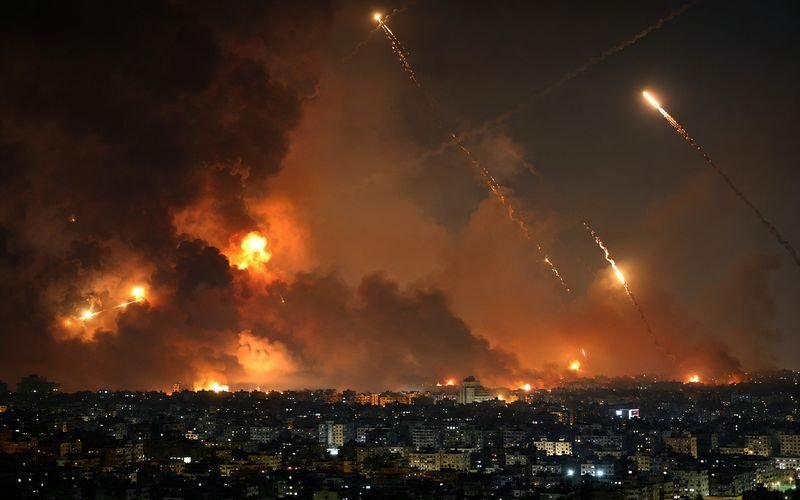
Tehran (Rajeev Sharma): The United States has launched a new wave of intense airstrikes against Iran following the killing of American service members in Jordan. The rapid escalation has pushed both nations closer to an all-out military conflict, effectively dismantling last month’s interim ceasefire deal. As the violence intensifies, shipping traffic through the critical Strait of Hormuz has ground to a near-total halt, raising global economic concerns. Meanwhile, retaliatory missile fire from Tehran toward Jordan has threatened to pull neighbouring Israel directly into the expanding regional warfare.
The US military’s Central Command confirmed that the latest aerial campaign specifically targeted Iran’s paramilitary Islamic Revolutionary Guard Corps (IRGC). American fighter jets and sea-launched Tomahawk cruise missiles struck coastal surveillance units, air defence facilities, and drone storage sites nestled within mountainous terrain. The Pentagon stated the operations are designed to degrade Tehran’s control over the strategic shipping straits. However, Iranian state television reported that the American strikes also hit the early-stage construction site of the Darkhovin nuclear power plant, though the International Atomic Energy Agency clarified the facility currently contains no nuclear material.
The escalating conflict has heavily impacted civilian infrastructure across the Middle East. The US military has targeted bridges, electrical grids, and water desalination plants within Iran over the past two weeks. In response, Tehran has launched extensive drone and missile strikes against US-allied Arab states. Air defence systems were heavily activated across Kuwait, Jordan, and Bahrain. Kuwaiti officials reported that a major power and desalination facility was struck for the second consecutive day, threatening vital drinking water supplies. The Gulf Cooperation Council has strongly condemned Iran’s infrastructure strikes, labelling them as war crimes.
The threat of a wider geographical spillover remains critical. The Jordanian military successfully intercepted multiple Iranian missiles over its territory, while Israel issued air-raid warnings to its citizens. The Israeli military launched interceptors near the southern city of Eilat to counter falling debris from missiles heading toward the neighbouring Jordanian port of Aqaba. Despite these close calls, Iran has primarily focused its retaliatory strikes on US-allied Arab nations rather than direct engagements with Israel, which initially launched the war alongside the US on February 28.
Diplomatic pathways are rapidly closing as the 60-day window established by the interim deal reaches its halfway mark. Following the latest hostilities, an Iranian negotiator announced that Tehran is officially suspending its commitments under the agreement, accusing Washington of gross violations. Iranian Supreme Leader Mojtaba Khamenei warned of severe consequences if the American offensive continues. Since the outbreak of the war, 16 US service members have been killed, while Iranian authorities reported at least 50 casualties from the weekend strikes alone, alongside massive global economic disruptions to fuel and commodity prices.
