

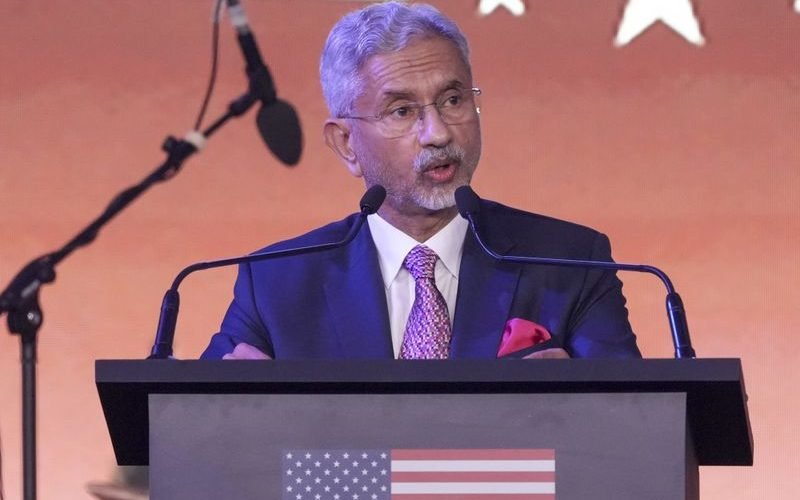
New Delhi (Gurpreet Singh): External Affairs Minister S Jaishankar on Tuesday called for a firm international response to terrorism, welcoming the United States’ decision to extradite Tahawwur Hussain Rana, an accused in the 2008 Mumbai terror attacks. Speaking at an event in Mumbai attended by US Secretary of State Marco Rubio, Jaishankar said India expected its partners to maintain a zero-tolerance approach towards terrorism.
The remarks came during a reception marking the 250th anniversary of American independence. Jaishankar linked the fight against terrorism with the broader India-US strategic partnership, saying both countries had a shared interest in strengthening security and stability amid changes in the global order.
What Did Jaishankar Say About Tahawwur Rana’s Extradition?
Jaishankar welcomed the US administration’s decision to extradite Rana, whom he described as one of the key culprits in the 26/11 attacks.
Addressing Rubio, the minister acknowledged his visit to the Taj Hotel memorial in Mumbai, where the US official had paid tribute to the victims earlier in the day.
“All of Mumbai, and indeed, all of India appreciates your laying a wreath today at the Taj Hotel’s 26/11 memorial,” Jaishankar said.
He added that India was clear about its right to defend itself against terrorism and expected its international partners to adopt an equally firm position.
The November 2008 Mumbai attacks targeted multiple locations across the city, including the Taj Mahal Palace Hotel. Six American citizens were among those killed in the attacks, Jaishankar noted.
Rana’s extradition was a significant point in the minister’s remarks on counterterrorism cooperation between New Delhi and Washington.
Jaishankar Calls For Stronger India-US Cooperation
Beyond counterterrorism, Jaishankar called for expanding cooperation between India and the US across trade, investment, technology and energy.
He said the international system was undergoing a transition, making closer coordination between countries with overlapping interests increasingly important. While acknowledging that each country would continue to pursue its national interests, he said expanding areas of convergence could strengthen bilateral ties.
The minister also highlighted the two countries’ shared interest in peace and stability across the Indo-Pacific, a region that has become central to their strategic engagement.
Jaishankar cited initiatives including the Quad, Mission 500, Pax Silica and the FORGE initiative as examples of the expanding relationship. He also pointed to cooperation in defence, energy and civil aviation.
According to the minister, India-US relations had developed over several decades despite differences in how the two countries approached certain international challenges.
Why Did Jaishankar Highlight Mumbai’s Role In India-US Ties?
Jaishankar described Mumbai as India’s financial capital, a centre for technology and research, and a cosmopolitan gateway connecting the country with the wider world.
He also referred to the historical relationship between India and the US, citing American support for India’s independence movement and subsequent cooperation in areas such as infrastructure, education, agriculture and technology.
Congratulating the US on its 250th anniversary, Jaishankar reaffirmed India’s commitment to strengthening the strategic partnership. He said sustained engagement and a focus on shared interests would help shape the relationship in the years ahead.
Rubio, speaking at the reception, described India and the US as key partners whose cooperation could help shape the 21st century. He particularly highlighted the importance of collaboration in technology and Indo-Pacific security.
The event brought counterterrorism and wider strategic cooperation into focus, with Jaishankar emphasising that the partnership should deliver progress on security as well as economic and technological priorities.
