

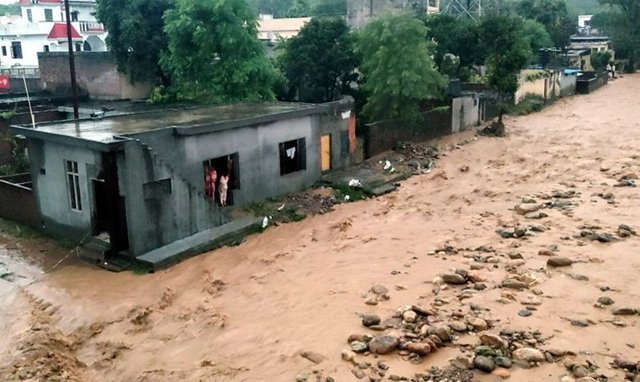
Poonch (Rajeev Sharma): Continuous rainfall across Jammu and Kashmir’s Poonch district turned deadly on Sunday after flash floods and landslides struck several villages, leaving at least four people dead while rescue teams continued searching for those feared trapped under debris.
Officials said Surankote emerged as the worst-hit area, where heavy downpours damaged homes, blocked roads and swelled streams, disrupting normal life. Disaster response teams, police and local volunteers have been mobilised to carry out rescue operations and provide relief to affected residents.
Among the victims was Nazia Kousar, 28, who died after her house collapsed in Noonabandi village. Her husband and three children survived the incident but sustained injuries. They were rescued from the rubble and admitted to a nearby hospital for treatment.
Another major rescue operation is underway in Lower Murrah, where a landslide buried a residential house. Authorities said Mohd Latief and five of his family members remain missing. Teams equipped with rescue gear are working in difficult conditions to locate the missing persons.
The extreme weather also claimed the life of a minor girl, Iram, who was swept away while crossing a stream in the Marhote area. In a separate incident, rescue workers recovered the body of an unidentified woman from a stream near Dhundak Lathoong Bridge.
Officials warned that persistent rainfall has significantly increased the danger of overflowing streams, flash floods and fresh landslides across hilly regions of the district. Residents living near vulnerable slopes and water bodies have been advised to remain cautious and avoid unnecessary movement.
Relief camps, emergency medical assistance and essential supplies are being arranged for families affected by the disaster. Authorities said restoration of damaged roads and other infrastructure is also underway, although rescue efforts remain the immediate priority.
The district administration has appealed to the public to follow weather advisories closely as forecasts indicate that unstable conditions may continue, posing further risks in landslide-prone areas.
