

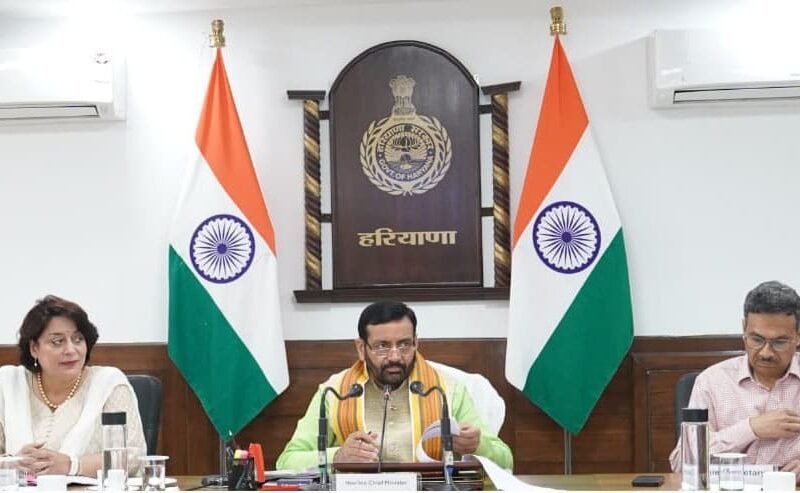
Chandigarh (Balwinder Singh): The Government of Haryana has initiated a comprehensive digital transformation within its Revenue and Disaster Management Department to establish transparent, technology-driven, and time-bound public services. Presiding over a high-level review meeting at Haryana Niwas in Chandigarh, Chief Minister Nayab Singh Saini directed all District Deputy Commissioners and senior administrative officers to ensure the seamless delivery of citizen-centric land reforms. A key highlight of the restructuring includes the operational success of the department’s first in-house Information Technology division, established in May 2025. This specialized technical unit, comprising software developers, system administrators, and UI/UX designers, has significantly minimized reliance on external agencies while accelerating the development of domestic digital platforms.
Central to these technical upgrades is the Integrated Revenue Portal, which offers an interconnected digital environment featuring single sign-on capabilities for officials and real-time tracking dashboards to monitor pending applications. To enhance public accountability, the Chief Minister mandated absolute transparency in the grievance redressal mechanism. Departmental officials must now provide explicit written reasons for any rejected public applications, maintain extensive digital logs, and conduct periodic random audits of rejected cases to protect eligible beneficiaries from procedural errors. Furthermore, local Circle Revenue Officers and Tehsildars have been directed to participate actively in weekly Samadhan Shivirs to settle public land disputes directly at the grassroots level.
The state’s land records modernization drive has made rapid strides, operating on an intensive mission mode. Financial Commissioner of Revenue Dr. Sumita Mishra reported that over 40.20 crore legacy revenue documents have been successfully digitized. Drone-based land surveys have already mapped approximately 44,000 square kilometres across Haryana, supported by 19 Continuously Operating Reference Stations to strengthen regional geospatial frameworks. Currently, 99 per cent of village maps have achieved geo-referencing, 60 lakh mutation maps have been updated, and nearly 60 per cent of the Record of Rights has been standardized. Additionally, 25.16 lakh property cards have been generated and distributed across 6,761 villages under ongoing land titling initiatives.
To eliminate fraudulent transactions, remove duplicate entries, and boost security, the department is actively linking traditional land registries with secure identity frameworks. Out of 1.69 crore land records, more than 42.55 lakh entries have already been systematically integrated, accounting for roughly 25 per cent of the state’s total volume. The administration has cleared over five lakh pending mutation cases, utilizing paperless document registration systems that generate over 15,000 crore rupees in state revenue. In tandem with these backend upgrades, physical land registration offices are being outfitted with modern public amenities, including comfortable waiting areas, digital queue management systems, and electronic token displays to streamline public visits.
The review meeting also outlined critical targets for agricultural digitization and healthcare expansion. The Chief Minister ordered a state-wide awareness drive to accelerate registrations under the AgriStack farmer registry by August 15, enabling cultivators to smoothly access digital agricultural benefits. Preparations are also underway for a comprehensive digital crop survey, targeting 100 per cent coverage across all villages starting mid-August, with the final audit scheduled by the end of the year. Concurrently, under the Chief Minister’s Good Governance Associates programme, the state reviewed the execution of the Ayushman Bharat and Chirayu Haryana healthcare schemes. Deputy Commissioners were instructed to conduct surprise inspections of public healthcare facilities to ensure that at least one government hospital in every district is upgraded to match the infrastructure and medical standards of premier private institutions.
