

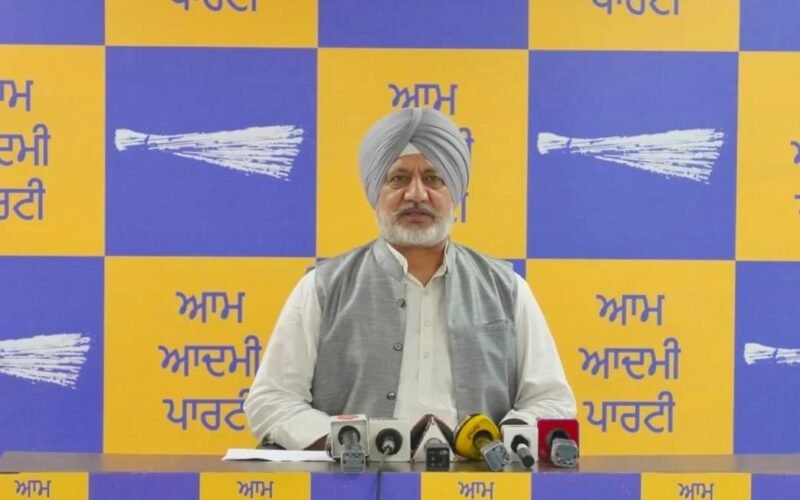
Chandigarh (Gurpreet Singh): Aam Aadmi Party (AAP) Punjab Media In-charge Baltej Pannu on Monday said the latest groundwater assessment has provided Punjab with a major reason for hope, as official figures show that the state has begun reversing a crisis that successive governments allowed to deepen for decades. He said the improvement was the outcome of the Bhagwant Singh Mann government’s sustained efforts to increase canal-water utilisation, strengthen canal infrastructure and reduce Punjab’s dependence on groundwater.
Addressing a press conference, AAP Punjab State Media In-charge Baltej Pannu said, “For decades, we heard about the need to save Punjab’s waters. We saw leaders calling themselves protectors of Punjab’s water, carrying symbolic tools and making emotional speeches. But the question is simple: what did they actually do? The answer is now before Punjab in the form of official data.”
Baltej Pannu said the Bhagwant Mann government had chosen a different approach by focusing on planning, infrastructure and implementation rather than slogans. The AAP government, he said, worked to ensure that Punjab utilised its own share of canal water, thereby reducing the burden on groundwater.
He said canal-water utilisation has now reached around 80% to 82%, compared with roughly 21% in 2022. “The government has activated 14,100 watercourses, restored more than 400 kilometres of defunct canals and concretised more than 1,000 kilometres of canals. Recharge points have also been developed along repaired canal infrastructure to help replenish groundwater,” he added.
Baltej Pannu said the impact of these measures is now visible in the latest groundwater assessment. “Punjab’s stage of groundwater extraction has fallen from 163.80% in 2021-22 to 156.36% in 2025 and further to 152.22% in 2025-26, representing an improvement of 11.58% points in four years. Annual groundwater extraction has also declined from around 28.01 billion cubic metres to 26.32 billion cubic metres. “11.58 percentage points may look like a number on paper, but for Punjab this means that we are finally moving in the right direction after decades of decline,” Baltej Pannu said.
He said the most encouraging aspect of the latest assessment is the improvement recorded across groundwater assessment blocks. “Out of Punjab’s 153 dark-zone blocks, 95 have shown improvement, while the number of critical blocks has fallen from 10 to 6. Four blocks have moved into the safe category, namely Arniwala in Fazilka, Makhu in Ferozepur, Hajipur in Hoshiarpur and Narot Jaimal Singh in Pathankot. Another 14 blocks have recorded significant improvement,” he added.
Baltej Pannu said groundwater recharge had also increased, with total annual recharge assessed at 19.14 billion cubic metres. “This includes 5.53 billion cubic metres through rainfall and 5.5 billion cubic metres through canal water. Canal-water recharge has increased from 4.5 billion cubic metres last year to 5.5 billion cubic metres this year,” he added.
He said the figures underline why reducing agricultural dependence on tubewells is critical for Punjab. “Of the 26.32 billion cubic metres of groundwater extracted, around 24.95 billion cubic metres is used for agriculture, while approximately 1.38 billion cubic metres is used for domestic and industrial purposes,” he added.
Baltej Pannu acknowledged that Punjab still faces a serious groundwater challenge. However, he said the direction of change was significant, with the latest assessment showing a decline in groundwater extraction and improvement in several assessment blocks. “This is the difference between governments that merely talked about Punjab’s water crisis and a government that decided to solve it. The Bhagwant Mann government has not reduced Punjab’s share of water to any other state; it has increased the utilisation of Punjab’s own canal-water share. The question the opposition must answer is: where was this water going when they were in power?” he said.
Baltej Pannu said the development was particularly important for Punjab’s next generation, as the state’s water crisis was ultimately a question of what future generations would inherit. “When history is written, our children should not ask us why we left them a desert. They should be able to say that their parents’ generation finally acted in time. The latest groundwater data gives Punjab that hope,” he said.
He said the same approach of governance, moving beyond slogans and delivering measurable outcomes, was visible in other sectors as well, including the strengthening of the Sadak Suraksha Force (SSF), government-school infrastructure and the public healthcare system. “The message from these figures is clear: if a government has the political will, Punjab’s problems can be solved. The Bhagwant Mann government has shown that commitment; now the results are beginning to speak for themselves,” Baltej Pannu said.
