

Chandigarh (Balwinder Singh) — The Haryana government is rapidly expanding the scope of vocational education in state-run schools, integrating modern disciplines such as Artificial Intelligence (AI) and Financial Technology (Fintech) alongside digital skill-based schooling. The strategic initiative aims to equip students with contemporary technical skills aligned with future global employment and higher education demands.
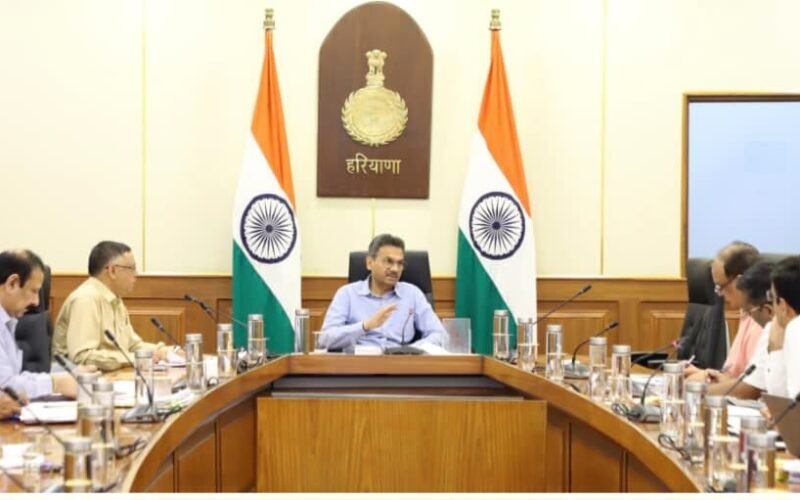
Reviewing the comprehensive blueprint during a high-level monitoring meeting of the Samagra Shiksha scheme, Chief Secretary Anurag Rastogi directed administrative officers and district deputy commissioners to accelerate institutional reforms. Rastogi emphasised the need to provide student-centric quality education, advanced state-of-the-art infrastructure, and industry-oriented competencies. He instructed all district deputy commissioners to implement targeted field strategies to secure one hundred per cent student enrollment and significantly improve institutional learning outcomes across the state.
Principal Secretary of the School Education Department, Vijay Singh Dahiya, detailed the phased expansion plan, announcing that the government will launch vocational training modules across 306 additional government schools in the initial phase. The expansion is projected to practically double vocational education coverage among secondary-level students, raising the enrollment ratio from thirty-one per cent to sixty per cent during the 2026-27 academic session. Dahiya noted that the long-term objective remains the universal integration of vocational training across all secondary and senior secondary government institutions. The department plans to supplement its fifteen existing vocational streams with specialized training in AI and Fintech, providing early technological exposure to prepare youth for emerging labor markets.
The structural evaluation metrics shared during the review meeting indicated positive outcomes from the ongoing pilot runs. Throughout the 2025-26 academic term, nearly 1.58 lakh students across classes six to eight in 1,382 government schools participated in skill orientation workshops, corporate internships, specialized projects, and interactive skill melas. At the secondary tier, 2.13 lakh students across 1,398 public schools are actively pursuing vocational tracks, with approximately forty-five per cent choosing specialized skill-based curriculums.
State Project Director Swapnil Ravindra Patil highlighted that the administration is simultaneously expanding multilingual proficiency. Currently, four thousand students across twenty-six government schools are learning French, with plans underway to introduce German language instruction in the next academic cycle. To enhance grassroots administrative governance, Additional Deputy Commissioners (ADCs) have been formally designated as nodal supervisors for district school education. The ADCs will oversee infrastructural updates, digital lab maintenance, sanitation standards, teacher competency parameters, and civil construction projects to drive rigorous local evaluation.
Comparative academic data from the U-DISE 2025-26 dashboard underscores that Haryana continues to outperform the national enrollment average. The state’s Gross Enrollment Ratio (GER) at the secondary stage stands at ninety-four per cent against the national benchmark of 81.5 per cent, while its senior secondary GER tracks at seventy-nine per cent compared to the national average of 61.7 per cent. State-sponsored support systems, including cost-free student transport networks, bicycle distribution drives, and the Student Transport Safety Scheme, have successfully driven sustained institutional attendance in rural pockets.
To reintegrate out-of-school youth, the department identified approximately two thousand dropouts in the fifteen to nineteen age bracket for the 2026-27 intake cycle. A financial allocation of forty lakh rupees has been sanctioned to subsidise board examination fees and educational stationery for economically vulnerable students, executed in structural partnership with the National Institute of Open Schooling (NIOS). The state will establish a model flexible learning institute in each district, alongside specialized teacher-led counseling workshops. Furthermore, official audits verified that one hundred per cent of state schools feature running electricity, safe drinking water systems, and separate gender-segregated toilets, while ninety-nine per cent are fully equipped with functional ICT labs, high-speed internet, STEM rooms, and smart classrooms. The comprehensive oversight meeting also evaluated the progress of 218 Model Sanskriti Schools, 251 PM SHRI Schools, 250 Mukhyamantri Excellence Incentive Schools, the expanded Super-100 development initiative, and the Mission Buniyaad platform, alongside assessing the institutional deployment of the School Accreditation Haryana (SACH) evaluation portal.
