

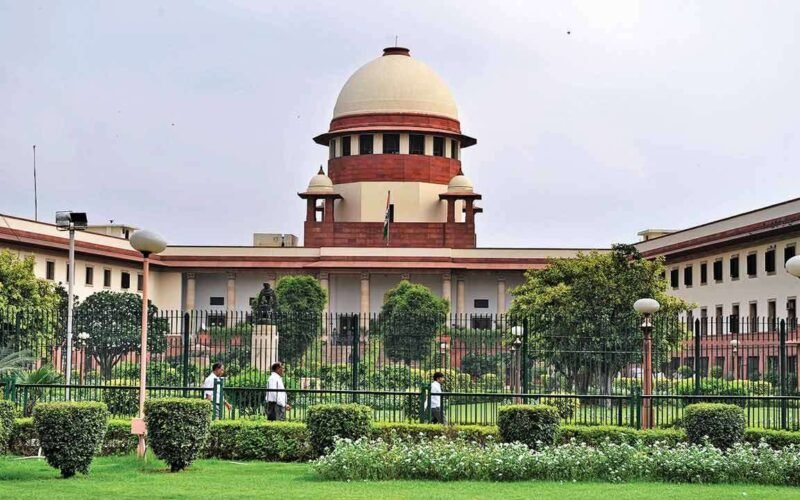
New Delhi (Gurpreet Singh): The Supreme Court has ruled that state governments cannot take ownership of religious or charitable institutions’ properties through gifts made by temporary trustees, stressing that such assets must be managed in the institution’s best interests rather than for administrative convenience.
A Bench comprising Justice PS Narasimha and Justice Alok Aradhe delivered the ruling on Friday while hearing a dispute over more than one acre of land belonging to the Nagapalayam Mariamman-Ponnachiamman Temple in Tamil Nadu’s Erode district.
The court struck down a gift deed through which S Bhoopathy, a temporary trustee of the temple, had transferred the property to the Tamil Nadu government. It also set aside a Madras High Court judgment dated March 19, 2019, and declared the gift deed executed on August 30, 2017, null and void.
What Did The Supreme Court Say About Temple Property?
The Bench emphasised that state governments, despite their role as custodians of religious and charitable institutions’ properties, cannot appropriate those assets or allow public officials to do so.
The court said decisions concerning the property of such institutions must be guided by their interests and benefits, not by the government’s administrative requirements.
It observed that transactions violating this principle could be invalidated regardless of how they were described or what public purpose was cited to justify them.
The judgment underlines the distinction between the state’s responsibility to protect religious and charitable property and any attempt to acquire or use such property through an arrangement that does not serve the institution’s interests.
Why Did The Court Declare The Gift Deed Invalid?
The dispute concerned temple land transferred to the Tamil Nadu government by Bhoopathy, who was serving as the institution’s temporary trustee. The Supreme Court found the gift deed legally unsustainable and set it aside.
The Bench also noted that the state had a statutory responsibility to safeguard the property. However, the government accepted the gift and continued to defend the transaction before both the Madras High Court and the Supreme Court.
The court made the observation while referring to the state’s position in the litigation and the subsequent affidavit submitted by the Chief Secretary of Endowments.
It imposed costs of Rs 1 lakh on the state, directing that the amount be paid to the temple within eight weeks.
Supreme Court Orders Rent Arrears And Revises Lease Terms
Although the court invalidated the gift deed, it did not cancel the lease granted to the government over the land.
Instead, it directed that the lease be renewed if it had expired, while setting the monthly rent at Rs 31,000 with effect from March 8, 2019, the date the land was handed over for construction.
The court further ordered that the rent be reassessed every three years under Section 34-A of the Tamil Nadu Hindu Religious and Charitable Endowments Act, 1959. The revised rent cannot fall below Rs 31,000 per month.
The temple trust will determine the lease period, renewal and remaining conditions in accordance with the 1959 law, keeping the temple’s interests as the primary consideration.
The state government has also been directed to clear rent arrears from March 8, 2019, onwards, after adjusting any payments already made. The outstanding amount must be paid to the temple within three months.
Tamil Nadu Authorities Directed To Follow Legal Procedure
The Supreme Court directed the relevant Tamil Nadu authorities to comply strictly with Sections 34, 34-A and 41 of the Tamil Nadu Hindu Religious and Charitable Endowments Act, 1959, in future matters involving such properties.
The ruling clarifies that a government’s role in overseeing religious institutions does not give it unrestricted authority over their assets. Any decision involving temple property must follow the applicable legal process and prioritise the interests of the institution concerned.
The case centres on a specific property dispute involving a temple in Erode district. The judgment establishes the court’s position on the limits of state authority in accepting gifts of religious or charitable property from temporary trustees.
