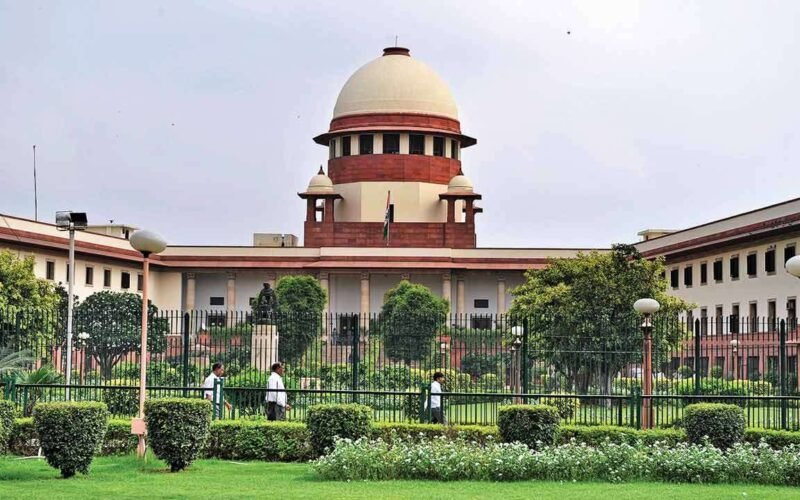
Indian judiciary

Supreme Court Rules State Cannot Take Over Temple Property Through Gift Deed, Sets Aside Madras HC Verdict

Supreme Court Rules State Cannot Take Over Temple Property Through Gift Deed, Sets Aside Madras HC Verdict

New Delhi (Gurpreet Singh): The Supreme Court has ruled that state governments cannot take ownership of religious or charitable institutions' properties through gifts made by temporary trustees, stressing that such assets must be managed in the institution's best interests rather than for administrative convenience. A Bench comprising Justice PS Narasimha and Justice Alok Aradhe delivered the ruling on Friday while hearing a dispute over more than one acre of land belonging to the Nagapalayam Mariamman-Ponnachiamman Temple in Tamil Nadu's Erode district. The court struck down a gift deed through which S Bhoopathy, a temporary trustee of the temple, had transferred…
Read More
President Promulgates Ordinance to Increase Supreme Court Judge Strength to 38

President Promulgates Ordinance to Increase Supreme Court Judge Strength to 38

New Delhi (Gurpreet Singh): In a significant move aimed at tackling case pendency and ensuring the timely delivery of justice, President Droupadi Murmu has promulgated an ordinance to expand the sanctioned strength of the Supreme Court of India. The Supreme Court (Number of Judges) Amendment Ordinance, 2026, officially raises the number of positions from 33 to 37, excluding the Chief Justice of India. With this legislative update to Section 2 of the Supreme Court (Number of Judges) Act, 1956, the country's highest court will now operate with a maximum capacity of 38 judges, including the Chief Justice of India. The…
Read More
Supreme Court Launches Samadhan Samaroh to Streamline Access to Justice Through Special Lok Adalat

Supreme Court Launches Samadhan Samaroh to Streamline Access to Justice Through Special Lok Adalat

Chandigarh (Naval Kishore): The Supreme Court of India has officially launched the “Samadhan Samaroh” (Special Lok Adalat) 2026, a landmark initiative designed to make the judicial process more accessible, efficient, and user-friendly for the general public. This ambitious programme commenced on April 21, 2026, and is set to culminate in a final three-day session scheduled for August 21, 22, and 23, 2026. By focusing on mutual consent and reconciliation, the initiative seeks to provide a swift resolution for eligible cases currently pending before the apex court, moving away from prolonged litigation toward a more collaborative and grounded approach to dispute…
Read More