

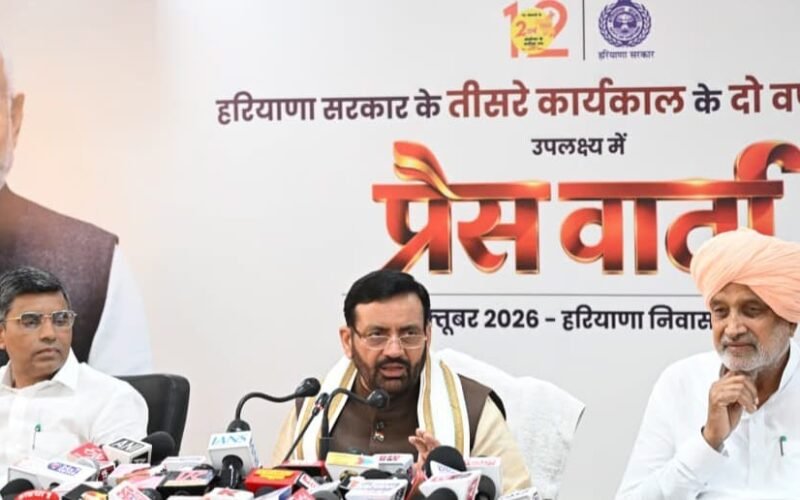
Chandigarh (Balwinder Singh): Haryana Chief Minister Nayab Singh Saini has outlined the state government’s infrastructure and industrial development agenda, including a target of attracting Rs 5 lakh crore in investment and generating 10 lakh employment opportunities over the next five years under its new industrial policies.
Speaking at a press conference in Chandigarh on October 17, 2026, to mark two years of the government’s third consecutive term, Saini highlighted road improvements, drinking water projects, urban expansion, support for small businesses and initiatives linked to cultural heritage and the welfare of families of martyrs.
Education Minister Mahipal Dhanda and Agriculture and Farmers’ Welfare Minister Shyam Singh Rana were also present at the event.
Haryana Reports Progress On Roads And Urban Infrastructure
Saini said Hansi had been made Haryana’s 23rd district. He also outlined road infrastructure projects undertaken under the state’s road improvement programme.
According to the chief minister, 4,227 roads spanning 9,410 kilometres were repaired at a cost of Rs 4,827 crore. He cited the construction of the Rewari bypass, costing Rs 1,070 crore, and the Pinjore bypass, built at a cost of Rs 170 crore.
The government has also committed to establishing 10 new Industrial Model Townships (IMTs), a promise included in its 2024 Assembly election manifesto.
In urban development, the Haryana Shehri Vikas Pradhikaran has initiated a land acquisition process covering approximately 1.67 lakh acres for the development of 849 new sectors across 71 cities, Saini said.
Drinking Water Projects And Panchayat Funding
The chief minister said the government had expanded water infrastructure in rural and urban areas through canal-based and tubewell-based water facilities.
He reported that 40 canal-based waterworks and eight tubewell-based facilities had been established at a cost of Rs 102 crore. Another Rs 184 crore had been spent on installing 537 tubewells and 188 boosting stations.
To improve household access to drinking water, the state laid 6,718 kilometres of pipelines at a cost of Rs 1,167 crore, according to the figures shared by Saini.
He also said Rs 3,919 crore had been allocated to Panchayati Raj institutions for development projects through various schemes and Finance Commission grants, with the stated aim of strengthening village-level infrastructure and local governance.
New Industrial Policies Target Investment And Employment
Industrial growth was a major focus of the government’s presentation. Saini said the Make in Haryana Industrial Policy 2026, along with 10 sector-specific policies, was introduced on June 1, 2026.
The policies aim to attract Rs 5 lakh crore in investment and create 10 lakh employment opportunities over five years. At the policy launch, 123 memorandums of understanding (MoUs) involving proposed investments of Rs 1.10 lakh crore were signed, according to the chief minister.
He also referred to an investment roadshow in Mumbai, where 17 agreements associated with investments worth Rs 66,821 crore were signed.
These figures represent investment commitments and agreements announced by the government; their eventual implementation and the jobs created will depend on the progress of the projects.
MSME Policy Focuses On Small Businesses And Exports
Haryana has also introduced a new MSME Policy 2026, with targets of attracting more than Rs 55,000 crore in investment, generating over five lakh jobs and doubling the state’s exports.
Saini said the policy was expected to benefit more than 14 lakh small businesses across Haryana.
He added that changes under the central government’s GST reforms, implemented from September 2025, had provided a benefit of Rs 2,652 crore to people in the state.
To assist businesses with tax-related matters, the government has established a startup GST facilitation cell in Gurugram and an MSME GST cell in Panchkula. Facilitation centres have also been opened at 27 tax districts, five range offices and the state headquarters.
The chief minister further cited the Vivadon Ka Samadhan scheme, introduced to resolve pending cases involving market traders and booth allottees.
Cultural Heritage And Religious Tourism Initiatives
Saini also highlighted projects aimed at promoting Haryana’s cultural and religious heritage. He said the government had established the Haryana International Gita Jayanti Mela Authority to promote the teachings of the Bhagavad Gita and develop Kurukshetra as an international tourism destination.
The Prime Minister had unveiled a replica of Lord Krishna’s sacred conch, Panchajanya, in Kurukshetra, Saini said. He also referred to the foundation stone being laid for a Sikh museum in the city, with a project cost of Rs 164 crore.
Under the Mukhyamantri Teerth Yatra Yojana, the government has facilitated visits for 1,700 senior citizens to Ayodhya, 1,517 to Takht Sri Hazur Sahib in Nanded and 1,109 to the Somnath temple in Gujarat, according to the figures presented at the press conference.
Financial Support For Martyrs’ Families And Other Groups
The chief minister said the state had increased financial assistance for families of armed forces and Central Armed Police Forces personnel killed in war from Rs 50 lakh to Rs 1 crore on December 28, 2024.
He added that annual scholarships had been introduced for children of martyrs, with assistance of Rs 60,000 for students in Classes 6 to 12, Rs 72,000 for undergraduate students and Rs 96,000 for postgraduate students.
The government has also made provision for an ex-gratia payment of Rs 1 crore to families of Agniveers who die in war, Saini said.
Other measures cited included an increase in the monthly pension for participants in the Matribhasha Satyagraha from Rs 15,000 to Rs 20,000, effective January 14, 2025.
At its October 10, 2026, meeting, the state Cabinet also decided to raise emergency financial assistance for media personnel from Rs 2.5 lakh to Rs 5 lakh.
Saini presented these initiatives as part of the government’s wider development and welfare agenda. The announced investment, employment and infrastructure targets will be measured by how effectively the proposed projects and policy commitments are implemented in the coming years.
