

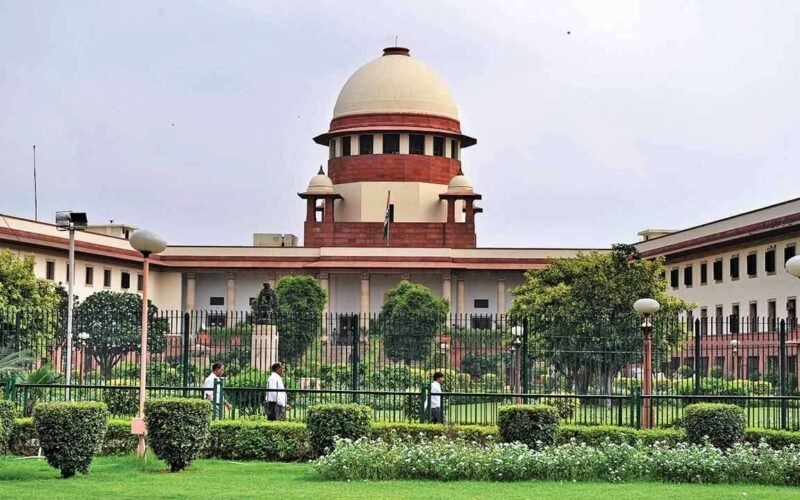
New Delhi (Gurpreet Singh)— Addressing widespread vacancies across subordinate courts throughout India, the Supreme Court has directed seven states that agreed to enhance the retirement age of judicial officers from 60 to 62 years to amend their service rules. The directive comes as nearly 24 per cent of the 30,868 sanctioned judicial posts across the country remain unfilled. A three-judge bench led by Chief Justice of India Surya Kant, alongside Justices Joymalya Bagchi and V. Mohana, ordered Chhattisgarh, Karnataka, Madhya Pradesh, Maharashtra, Sikkim, Tamil Nadu, and West Bengal to effect the changes as soon as possible, preferably within two months.
The top court clarified that the extension beyond 60 years will remain subject to a performance and suitability assessment of the judicial officer by their respective high court. Pending the formal amendment of service rules, the bench ordered that no judicial officer in the seven states who reaches the age of 60 shall be superannuated until turning 62, provided they clear the high court’s evaluation. Furthermore, officers in these states who retired on or after March 31, 2026, will be offered an option to rejoin judicial service, provided they have not secured subsequent employment or assumed an office of profit under the central or state governments. Those choosing to return will receive consequential benefits regarding pay, seniority, and continuity of service, subject to high court appraisal and the surrender of post-retirement benefits already drawn.
Emphasizing the urgency of institutional stability, the bench underscored that curbing the loss of experienced judicial personnel is vital to narrowing the gap between sanctioned posts and working strength, ensuring that access to justice does not become illusory. The court dismissed the financial apprehensions raised by several state administrations as misplaced. It noted that retiring officers at 60 requires governments to pay post-retirement benefits alongside the salaries of newly recruited successors, whereas extending service to 62 defers the outflow of terminal retiral dues.
The Supreme Court also granted non-consenting states and union territories, including Haryana and Himachal Pradesh, a two-week window to reconsider their position on enhancing the superannuation age of the district judiciary. The court has scheduled the matter for its next hearing on October 1
