

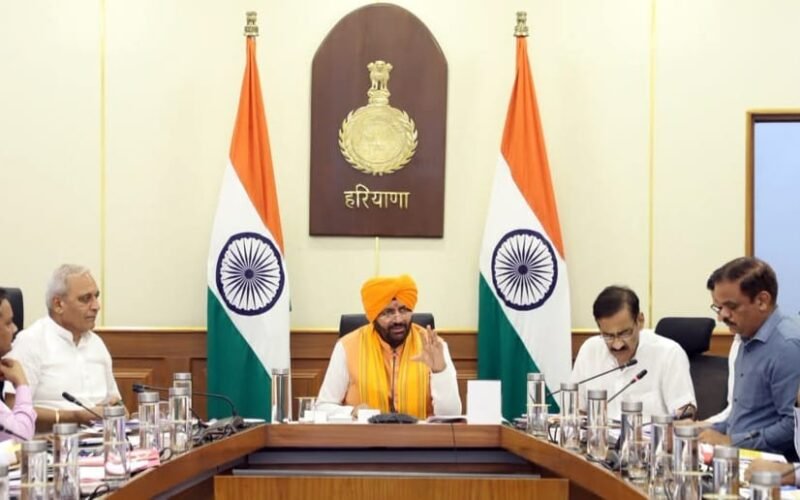
Chandigarh (Balwinder Singh): Haryana Chief Minister Nayab Singh Saini chaired a high-level review meeting on the state’s ‘Reuse of Treated Waste Water (TWW) Policy’ on Tuesday, stressing that water conservation remains a top priority for the state. Emphasizing the need for a planned and scientific approach to wastewater management, the Chief Minister noted that reusing treated water will reduce pressure on groundwater reserves and drinking water sources while ensuring long-term supply for industries, power plants, agriculture, and green belts. Public Health Engineering Minister Ranbir Gangwa and senior administrative officials attended the meeting to outline state distribution strategies.
The Chief Minister issued strict directives ensuring that no treated water goes to waste across Haryana’s 207 operational Sewage Treatment Plants (STPs) and Common Effluent Treatment Plants (CETPs). Under the policy framework, thermal power plants will receive top priority for treated water supply to replace fresh water usage, followed by industrial zones, green belts, parks, and agricultural fields. To streamline execution, Chief Minister Saini ordered complete mapping of all treatment facilities to track daily capacity, discharge levels, and distribution networks. Under the state’s Vision@2047 roadmap, Haryana aims to achieve 100 per cent reuse of treated wastewater by March 2031.
State officials presented a phased implementation plan developed by the Irrigation and Water Resources Department. Under Phase 1, a 500-crore rupee project funded by NABARD covers 35 STPs across 21 districts, with 27 plants designated for micro-irrigation networks expected to serve nearly 40,000 acres of farmland. Phase 2 expands the initiative to 57 additional STPs with a combined capacity exceeding 528 MLD. To maintain operational efficiency, the Chief Minister instructed departments to install solar power systems under the PM-KUSUM scheme at treatment plants, reducing electricity costs and ensuring uninterrupted 24-hour plant operations.
To ensure strict quality standards and local compliance, the state will conduct joint inspections of STPs installed across approximately 678 private residential society colonies in coordination with the Haryana State Pollution Control Board and municipal bodies. The Chief Minister directed authorities to adopt a cluster-based distribution model linking nearby treatment facilities and required all relevant departments—including Public Health Engineering, Irrigation, Urban Local Bodies, Power, and Industry—to submit comprehensive operational reports within 15 days to formulate a unified statewide action plan.
