

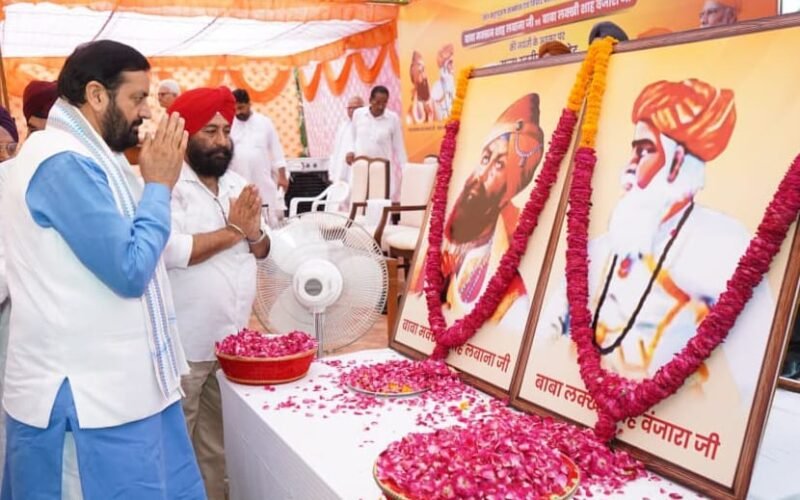
Chandigarh (Balwinder Singh): The life stories of Baba Makhan Shah Labana and Baba Lakhi Shah Banjara represent immortal chapters of sacrifice, service, and deep spiritual commitment in Indian history. Speaking at a state-level birth anniversary commemoration at Sant Kabir Kutir in Chandigarh, Haryana Chief Minister Nayab Singh Saini underscored that great spiritual leaders do not belong to any single community or caste but remain a shared heritage for the entire nation. Saini reiterated that the provincial government remains dedicated to preserving these historic contributions for future generations through its structured Saint-Consciousness and Thought Propagation Scheme.
During the commemorative gathering, representatives from the Banjara and Labana communities formally presented a charter of demands to the administration. Assuring full executive support for their welfare, the Chief Minister announced an immediate financial grant of 31 lakh rupees to expedite land clearance and construction activities for the Makhan Shah Labana Dharamshala in Pehowa. Furthermore, Saini sanctioned an additional 31 lakh rupees for the establishment of a state-of-the-art community centre in Datoli village, while indicating that a prominent educational or public institution would soon be named in honour of Baba Makhan Shah Labana.
Evoking pivotal moments from Sikh history, the Chief Minister recalled the immense courage displayed by Bhai Lakhi Shah Banjara and his son, Bhai Nigahiya, during the repressive period of Mughal rule. Following the martyrdom of the ninth Sikh guru, Sri Guru Tegh Bahadur Sahib Ji, at Chandni Chowk, Lakhi Shah Banjara risked his life to transport the Guru’s mortal remains to his own residence, setting the home ablaze to perform the final rites respectfully. Today, Gurdwara Rakab Ganj Sahib in New Delhi stands as a lasting monument to that extraordinary act of devotion. Saini also noted how the British colonial administration unjustly targeted these nomadic trading communities via the Criminal Tribes Act of 1871, a historical stigma officially revoked post-independence on August 31, 1952, which is now celebrated annually as Vimukti Diwas.
Linking the egalitarian philosophy of these historic figures to contemporary governance, Saini detailed how Haryana’s administrative framework operates strictly on the principle of Antyodaya—uplifting the very last citizen in the social hierarchy. He highlighted that through the flagship Parivar Pehchan Patra digital registry, targeted welfare distribution has achieved unprecedented transparency. Under provincial housing schemes, over 1.5 lakh vulnerable families have received permanent homes, while financial assistance under the Dr. B.R. Ambedkar Housing Renewal Scheme has been enhanced from 30,000 rupees to 80,000 rupees to support extensive home renovations for economically weaker sections.
The Chief Minister expanded on comprehensive safety nets established by the state, noting that the Deen Dayal Upadhyaya Antyodaya Parivar Suraksha Yojana has distributed 2,800 crore rupees to over 74,000 households facing the loss of a primary breadwinner. Additionally, over 13 lakh low-income families are being provided subsidized domestic gas cylinders at 500 rupees per month. Educational support mechanisms have also been reinforced, including free textbooks, uniforms, and competitive examination coaching alongside specialized annual scholarships ranging between 8,000 and 12,000 rupees for meritorious students from marginalized backgrounds. Saini concluded by urging citizens to align with the national developmental vision to propel Haryana toward new milestones of inclusive progress.
