

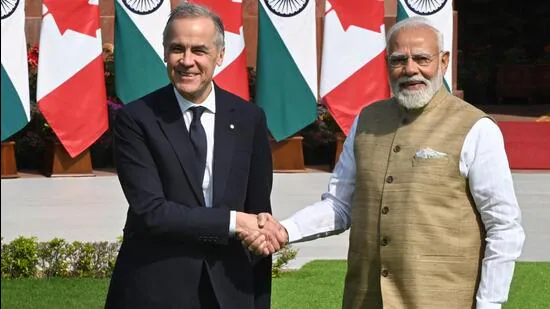
New Delhi/Ottawa (Gurpreet Singh/ Rajeev Sharma): In a landmark diplomatic breakthrough, Prime Minister Narendra Modi and Canadian Prime Minister Mark Carney issued a comprehensive Joint Leaders’ Statement on Monday, March 2, 2026, marking a definitive “reboot” of bilateral relations. This visit- the first by a Canadian Prime Minister since 2018 signals a shift toward pragmatic economic cooperation and strategic alignment under the guiding philosophy of “Vasudhaiva Kutumbakam” (One Earth, One Family, One Future).
The two leaders have committed to a multi-layered roadmap designed to elevate India-Canada ties into a resilient, 21st-century partnership that balances high-tech innovation with traditional energy security and deep people-to-people connections.
1. Economic Anchor: The Path to a $70 Billion Trade Goal
The cornerstone of the visit is the formal launch of negotiations for the Comprehensive Economic Partnership Agreement (CEPA).
- Trade Target: The leaders set an ambitious target to expand bilateral trade to CAD 70 billion (approximately ₹4.65 lakh crore) by 2030.
- Timeline: Both nations have pledged to conclude these high-stakes negotiations by the end of 2026.
- Financial Integration: A new Finance Ministers’ Economic and Financial Dialogue was launched to modernize payments. This includes a collaboration between the National Payments Corporation of India (NPCI) and Payments Canada to explore instant cross-border remittances and merchant payments, benefiting students and SMEs.
2. Strategic Energy Partnership: Nuclear and LNG Security
Recognizing their complementary roles as energy powers, India and Canada have moved to secure long-term supply chains.
- The Uranium Deal: A massive CAD $2.6 billion agreement was signed between Canada’s Cameco and India’s Department of Atomic Energy for the long-term supply of uranium, fueling India’s civil nuclear energy expansion.
- Fossil Fuel Diversification: Canada, aiming to produce 50 million tons of LNG per year by 2030, is positioning itself as a primary supplier for India’s growing energy demand. Discussions are also underway for India’s first long-term LPG supply arrangement with Canadian firms.
- Clean Tech Alliances: Canada announced its intention to join the International Solar Alliance and upgraded its participation in the Global Biofuels Alliance to a full member.
3. “One Family”: Talent Mobility and Education
With over 425,000 Indian students in Canada, the “One Family” pillar focuses on protecting and enhancing this human bridge.
- Research Internships: An MOU between India’s AICTE and Canada’s MITACS will allow 300 Indian undergraduate students annually to undertake research placements at Canadian universities.
- Offshore Campuses: The leaders agreed to facilitate the establishment of offshore campuses of Canadian institutions in India, aligning with India’s Viksit Bharat vision.
- Indigenous Exchange: A new focus on Indigenous and Tribal communities was established, with the Bharat Tribal Festival (BTF) 2026 serving as a platform for global cultural and entrepreneurial exchange.
4. “One Future”: Space, AI, and Critical Minerals
The partnership is looking toward the stars and the digital frontier to secure technological sovereignty.
- Space Robotics & Exploration: Building on 30 years of cooperation, ISRO and the Canadian Space Agency (CSA) will collaborate on space robotics, human spaceflight, and quantum communication.
- AI Sovereignty: The leaders agreed to integrate AI into aerospace technologies and use AI-assisted diagnostic tools for remote healthcare in both countries.
- Critical Minerals: A new MOU on Critical Minerals Cooperation was signed to build resilient supply chains for semiconductors and electric vehicle batteries, supporting India’s mineral stockpiling initiatives.
5. Foundational Layer: Security and Indo-Pacific Stability
To ensure a stable environment for this growth, the leaders institutionalized new security mechanisms.
- Defence Dialogue: An India-Canada Defence Dialogue has been established to identify joint training and supply chain resilience opportunities.
- Maritime Security: A new Maritime Security Partnership was launched, focusing on the Indian Ocean Region.
- Diplomatic Normalization: Both sides welcomed the return of diplomatic representatives and the appointment of a Canadian Defence Attaché to New Delhi, signaling a return to formal, high-level institutional engagement.
