

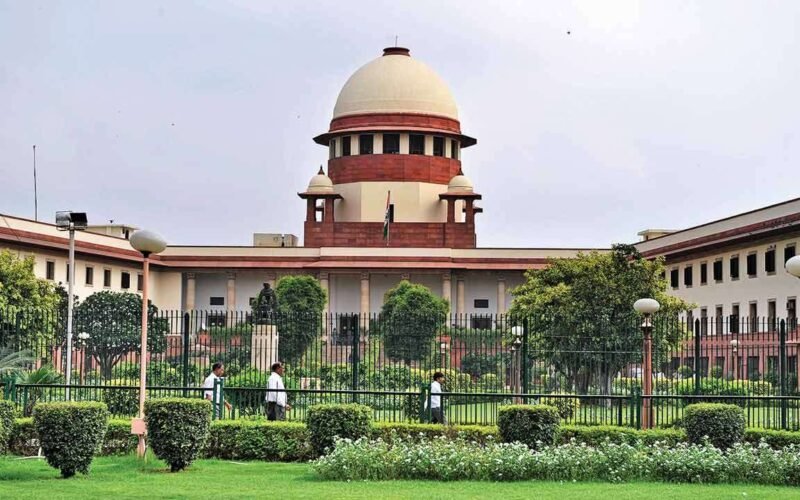
New Delhi (Rajeev Sharma): The Supreme Court of India has begun examining a set of petitions challenging the constitutional validity of the Transgender Persons (Protection of Rights) Amendment Act, 2026, issuing notices to the Union government, all states, and Union Territories for their formal responses.
A bench comprising Chief Justice Surya Kant and Justice Joymalya Bagchi heard preliminary arguments on Monday and scheduled the matter for detailed hearing after six weeks. The court also directed the respondents to file their replies in the meantime.
During the hearing, senior advocate A. M. Singhvi argued that the amended law undermines the principle of self-determined gender identity, which he said forms a core aspect of constitutional rights for transgender persons. He further cautioned that individuals undergoing hormonal or medical transition could face complications under the revised framework, though no request for an immediate stay was pressed since the law has not yet been formally brought into effect.
The Bench also heard submissions from a transgender petitioner who has filed a caveat in the case. The petitioner urged the court not to pass any interim orders, stating that discussions with the government were still ongoing and that judicial intervention at this stage could affect the consultation process. Despite this, the court proceeded to issue notices to all respondents.
The amendment in question was passed by Parliament during the Budget session and received presidential assent from Droupadi Murmu on March 30. It modifies the earlier Transgender Persons (Protection of Rights) Act, 2019 by redefining eligibility criteria for recognition as a transgender person and strengthening penalties for crimes involving coercion or harm related to identity.
Petitioners, including activist Laxmi Narayan Tripathi and inclusion professional Zainab Patel, have argued that the changes violate fundamental rights guaranteed under the Constitution, including equality, non-discrimination, freedom of expression, and the right to life and personal liberty.
They have also questioned whether the State can override an individual’s self-perceived identity through statutory definitions, arguing that the requirement of certification through a medical board-based process infringes on privacy rights. The petitions further rely on the precedent set in the NALSA v. Union of India (2014), which recognized self-identification of gender as a fundamental right.
The law has drawn criticism from sections of the LGBTQIA+ community, with concerns raised over the lack of consultation before its passage. Some members of the National Council for Transgender Persons have reportedly resigned in protest, while former judge Asha Menon has publicly urged reconsideration of the amendment.
The case is expected to become a significant constitutional test case, potentially shaping the future of transgender rights and identity recognition in India.
