

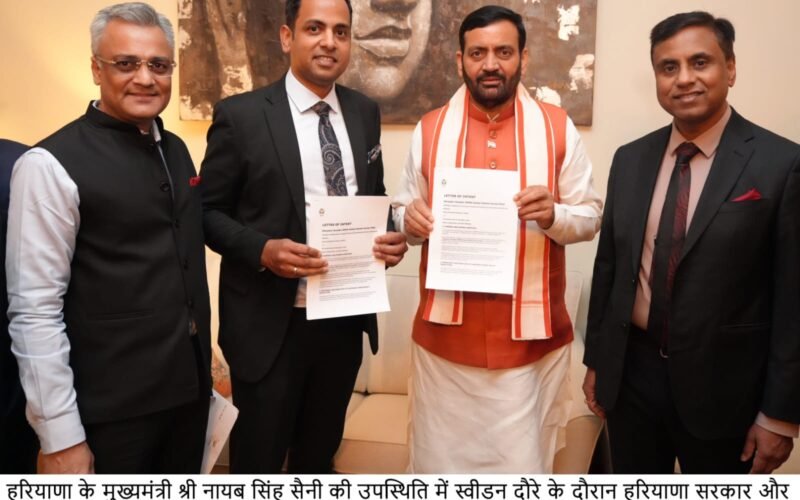
Chandigarh (Balwinder Singh): Haryana has signed Letters of Intent (LoIs) worth Rs 4,000 crore with Swedish companies during Chief Minister Nayab Singh Saini’s visit to Sweden, with the proposed investments expected to support industrial development, retail expansion, warehousing infrastructure and employment generation. The announcement was made on October 16, 2026, as the state seeks to strengthen its economic ties with Sweden.
The agreements include an LoI worth Rs 3,000 crore linked to the government’s vision of a strong and self-reliant India, along with proposals worth Rs 1,000 crore in the retail and warehousing sectors. Haryana Urban Local Bodies Minister Vipul Goel accompanied the Chief Minister during the visit. The state government has presented the agreements as a step towards attracting international investment and creating opportunities for its skilled workforce.
What Is Included In Haryana’s Rs 4,000 Crore LoIs?
According to the Haryana government, the proposed investment commitments are divided into two broad components.
The first is an LoI worth Rs 3,000 crore aligned with the vision of a strong and self-reliant India. The government has not specified in the announcement the individual companies involved or provided a detailed sector-wise breakdown of this component.
The remaining Rs 1,000 crore relates to the retail and warehousing sectors. The proposed investments are expected to support the development of modern warehousing infrastructure, the expansion of retail chains and growth in logistics-related activity.
These sectors could create demand for workers across supply chains, storage, distribution and retail operations if the proposals progress to implementation. However, the number of jobs expected to be created and the timelines for the proposed investments have not been specified in the announcement.
The Rs 4,000 crore figure represents the value of the signed Letters of Intent. It should not be interpreted as investment already deployed in Haryana, as the announcement does not establish that the entire amount has been converted into operational projects.
Gurugram And Stockholm To Collaborate On Urban Development
Another key outcome of the visit is a city-to-city collaboration agreement between Gurugram and Stockholm. The two cities are expected to work together in areas including technological innovation, smart-city solutions, sustainable urban development, knowledge exchange and investment promotion.
The proposed partnership is intended to strengthen institutional links between the cities and create opportunities to share experience and expertise in urban planning and development.
For Gurugram, which has emerged as a major business and commercial centre in Haryana, cooperation with Stockholm could provide a platform to explore approaches to modern urban management and sustainable development. The government has not, however, announced specific project timelines or implementation targets for the collaboration.
Swedish Companies Expected To Offer Jobs To Haryana’s Youth
Employment generation is another focus of Haryana’s outreach to Sweden. The state government said Swedish companies had assured it of opportunities for Haryana’s skilled young people.
The proposed cooperation is expected to open avenues for skill development, training and employment linked to international industry standards. The announcement did not disclose the number of positions expected to be offered or identify the companies that would provide them.
Chief Minister Nayab Singh Saini said the visit was an important step towards strengthening Haryana’s position on the global investment map. He said Sweden’s technology, innovation and sustainable development experience could be combined with Haryana’s economy and workforce to support the vision of a self-reliant India.
The state government has also said it will provide the necessary support to help move the proposed investments towards implementation.
The next stage will be to translate the LoIs into concrete projects, with details on participating companies, investment schedules and employment commitments likely to determine their eventual impact on Haryana’s economy.
