

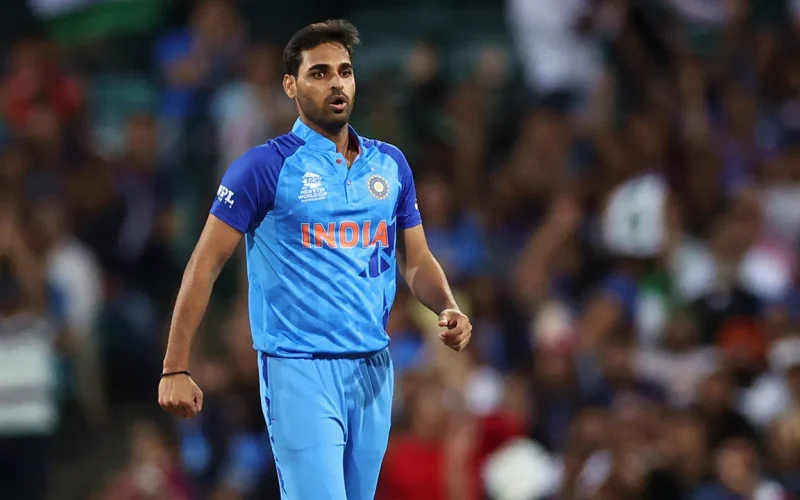
Bengaluru (Gurpreet Singh): Veteran fast bowler Bhuvneshwar Kumar is on the verge of returning to India’s T20I setup after nearly four years, having been added to the squad for the fifth and final T20I against West Indies. The 36-year-old has been called up after Arshdeep Singh sustained a blow to his bowling shoulder during the fourth match in Hyderabad on Wednesday.
The series decider is scheduled to take place at the M Chinnaswamy Stadium in Bengaluru on Saturday, October 17, with the five-match contest level at 2-2. Bhuvneshwar’s inclusion gives India an experienced pace option ahead of the crucial encounter, although the Board of Control for Cricket in India (BCCI) has not confirmed whether he will play.
The selection committee added the Uttar Pradesh pacer to the squad on Friday. The BCCI said a decision on Arshdeep’s availability would be taken before the match, depending on his recovery.
When Did Bhuvneshwar Kumar Last Play A T20I For India?
Bhuvneshwar’s last T20I appearance for India came against New Zealand in Napier on November 22, 2022. His inclusion in the squad for the West Indies series finale has therefore raised the possibility of an international return after almost four years.
The pacer was already part of India’s plans for the upcoming T20I series against New Zealand, which begins on October 22. His addition to the squad for the Bengaluru match brings that potential return forward.
However, his selection should not be confused with confirmation of a place in the playing XI. The team management will decide on his participation before the game, while Arshdeep’s fitness remains a factor.
A Potential Comeback At The Venue Of His Early India Career
Bengaluru could provide a fitting setting for Bhuvneshwar’s return. The pacer made his T20I debut against Pakistan in 2012, beginning an international career that saw him become one of India’s leading swing bowlers.
Known for his ability to move the new ball and use variations at the death, Bhuvneshwar has built a reputation around control, accuracy and the ability to trouble batters in different phases of an innings.
His experience could be particularly relevant in a series that has produced high scores and sees both teams enter the final match with two wins apiece. India will be looking for options capable of restricting a West Indies batting line-up that has shown its scoring potential throughout the contest.
How Bhuvneshwar Kumar Rebuilt His T20 Game
Although he has been away from India’s T20I team, Bhuvneshwar has continued to feature in the Indian Premier League. His performances for Royal Challengers Bengaluru in the 2025 and 2026 editions have helped keep him in contention for a return to the national setup.
He took 45 wickets across 30 matches for RCB during that period, according to the figures cited in reports on his recall.
RCB assistant coach Omkar Salvi has previously highlighted the bowler’s understanding of his own game and his ability to adapt to the demands of T20 cricket. Bhuvneshwar’s experience with the new ball, along with his slower deliveries and other variations, remains a key part of his skill set.
The potential comeback also comes at a time when India are preparing for the next phase of their international schedule, including the T20I series against New Zealand later this month.
India vs West Indies: What Happens In The Fifth T20I?
With the series tied 2-2, Saturday’s match will decide the winner of the five-game contest. West Indies levelled the series with a 24-run victory in the fourth T20I, putting pressure on India ahead of the finale.
Captain Shai Hope has been among the standout performers for West Indies, scoring 261 runs in the first four matches, including two centuries. India will need an effective bowling performance to contain the opposition’s powerful batting line-up.
Bhuvneshwar’s recall gives the team another experienced option, but his involvement will depend on the final selection decision. If he takes the field, it will mark his first T20I appearance for India since November 2022 and another chapter in a career that began on the international stage in 2012.
