

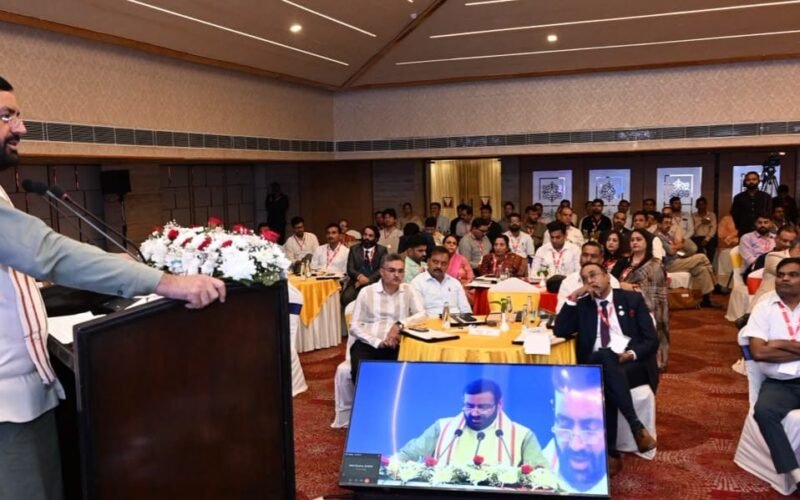
Chandigarh (Balwinder Singh): The Haryana government plans to strengthen its state revenue framework not by raising tax rates, but by expanding the tax base, enhancing compliance, plugging revenue leakages, and deploying modern technology. Chief Minister Nayab Singh Saini stated this objective while inaugurating a national conference on analysing and strengthening the state’s tax-revenue system for a developed Haryana by 2047, organized by the Swarna Jayanti Haryana Institute for Fiscal Management in Chandigarh. The event brought together key policymakers, including Chief Economic Adviser to the Government of India V. Anantha Nageswaran, alongside administrative secretaries, economists, and public finance experts.
Saini emphasized that Haryana’s own tax revenue currently stands at under 7% of Gross State Domestic Product. The government has set a definitive target to elevate this figure to 10% by 2030 and 15% by 2047. Underscoring that honest taxpayers will not be burdened with additional levies, he outlined that the growth would stem from economic diversification, administrative efficiency, and systemic reforms. Between April and August 2026, Haryana recorded a 29% increase in State Goods and Services Tax collections, reaching 24,662 crore rupees compared to 19,174 crore rupees in the corresponding period of the previous year. In August alone, the state logged a 21% SGST rise, comfortably outpacing the national average growth rate of 13%. While Haryana accounts for less than 4% of the country’s registered GST taxpayers, it contributes approximately 7.7% of total national GST collections.
The Chief Minister highlighted the state’s rapid structural transformation from an agrarian base toward industrial and high-value service sectors. Major growth drivers include global capability centres, IT, and artificial intelligence hubs in Gurugram, alongside mega industrial projects such as the India International Horticulture Market in Gannaur, vehicular manufacturing complexes at IMT Kharkhoda, and logistics corridors across Rewari and Hisar. These modern investments complement traditional manufacturing and MSME clusters, including Panipat’s textiles, Ambala’s scientific instruments, Hisar’s steel, Yamunanagar’s plywood, and Rohtak’s automotive fasteners.
To resolve historic tax disputes and reduce litigation, the state extended the deadline for the Haryana One Time Settlement Scheme 2026 until November 30, following positive uptake from over 115,000 businesses during the 2025 iteration. Concurrently, administrative workflows are transitioning to digital mechanisms such as Paperless Registration 2.0 and automated land mutations. Looking ahead, tax enforcement will increasingly rely on artificial intelligence, machine learning, and integrated data analytics by linking GST records with property registries, transport, power utilities, and urban development databases to identify risks and curb evasion without inconveniencing compliant taxpayers.
Addressing the forum, Chief Economic Adviser V. Anantha Nageswaran commended Haryana’s fiscal resilience and structural reforms, observing that the state holds the economic momentum and governance capacity to reach a 1.5 trillion dollar economy by 2047. He noted that Haryana’s own tax revenue maintains a balanced profile, with state GST balanced between intra-state trade at 51% and integrated GST settlement at 49%. Nageswaran advocated for trust-based regulatory standards, reduced compliance burdens for small enterprises, and systematic property tax reforms, including annual property valuations and transparent record linkage, to support sustainable public finance.
