

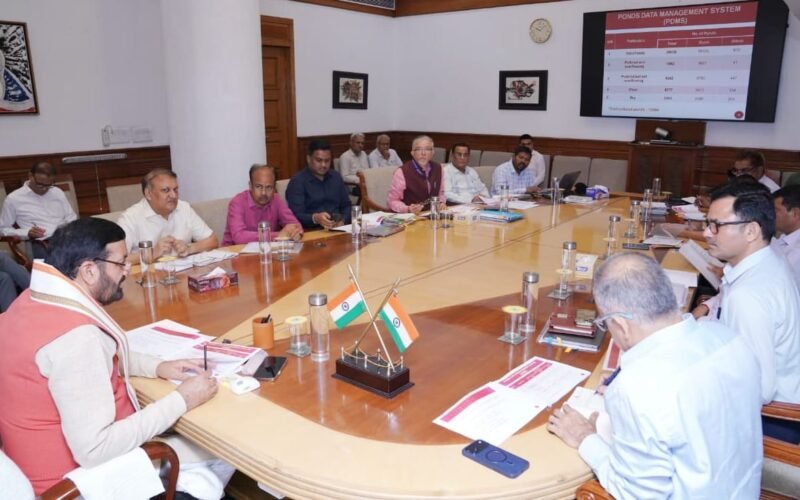
Chandigarh (Balwinder Singh): Haryana Chief Minister Nayab Singh Saini chaired a high-level review meeting of the Haryana Pond and Wastewater Management Authority in Chandigarh, directing officials to prioritize the comprehensive restoration, beautification, and maintenance of water bodies across rural and urban pockets. The Chief Minister emphasized that structural steps must be taken to ensure sewage and dirty water are entirely prevented from flowing directly into local ponds, preserving both the rural ecology and community health.
Under the state’s ongoing alignment with the Amrit Sarovar Yojana, the Chief Minister instructed departments to mandate routine desilting, regular cleaning, and robust bank stabilization for all state ponds, alongside ensuring absolute transparency and high-quality standards in all related construction contracts. For populated village centers where ponds have become tightly surrounded by residential habitations, specialized sanitation protocols will be implemented. The authority will install concrete walking tracks, public seating benches, and eco-friendly solar lighting systems around larger water bodies to transform them into recreational public spaces.
To ensure efficient waste processing, the Chief Minister ordered the widespread development of the engineered “Three-Pond System” across villages. This multi-layered natural filtration mechanism treats and purifies domestic graywater before it enters the primary water body, preventing direct ecological contamination. The state administration has delegated the core operational responsibility for daily upkeep and micro-management to the respective local Gram Panchayats, with regional administrative bureaucrats tasked with carrying out periodic inspections to identify and rectify maintenance gaps immediately.
The review revealed that Haryana currently houses a total of 20,039 ponds, comprising 19,129 rural water bodies and 910 urban ponds. Out of these, comprehensive rehabilitation and cleansing work has already been completed across 6,777 sites, with remaining locations scheduled for restoration in a phased manner. To ensure economic sustainability, the Chief Minister suggested leveraging larger ponds for commercial pisciculture (fish farming) through a transparent online auction portal, with all generated revenues redirected back to local pond preservation funds. Ahead of the monsoon season, the public works and irrigation branches were additionally ordered to execute a swift clean-up of all arterial drains to prevent waterlogging.
