

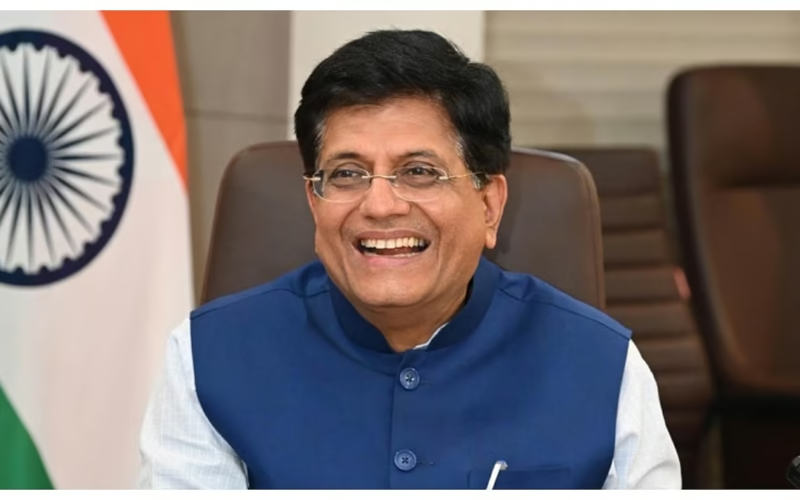
New Delhi/Ottawa (Gurpreet Singh): Union Minister of Commerce and Industry Piyush Goyal is scheduled to lead a high-level business delegation to Canada from May 25 to 27, 2026, aiming to fast-track ongoing free trade discussions and catalyse fresh sovereign investments. The ministerial tour marks a pivotal moment in bilateral diplomacy following the official revival of economic engagement between New Delhi and Ottawa earlier this year. Goyal’s itinerary features targeted institutional dialogues in Ottawa on May 25, followed by an intensive two-day commercial outreach program in Toronto designed to bridge industrial alignments and reinforce supply chain resilience.
The central anchor of the ministerial visit is the advancement of the India-Canada Comprehensive Economic Partnership Agreement negotiations. The strategic framework was formally set in motion on March 2, 2026, when both nations signed the official Terms of Reference for the CEPA during a state visit to India by Canadian Prime Minister Mark Carney. At the signing ceremony at Hyderabad House, Prime Minister Narendra Modi outlined an ambitious bilateral roadmap, targeting a trade expansion volume of 50 billion US dollars by 2030, while Canadian officials expressed a parallel desire to unlock long-term investments. Since the foundational agreement, technical teams have moved with notable velocity, successfully concluding two rounds of structured negotiations, including a comprehensive session in New Delhi from May 4 to 8 that audited complex regulatory chapters spanning market access for goods, cross-border services, intellectual property protocols, rules of origin, and sanitary measures.
Welcoming the high-profile ministerial mission, the Federation of Indian Export Organisations characterized the visit as a decisive milestone for expanding India’s outbound commercial footprint. FIEO President S.C. Ralhan stated that the proposed trade pact would yield substantial market advantages for domestic manufacturing units, particularly micro, small, and medium enterprises, by systematically dismantling tariff barriers, simplifying customs procedures, and fostering research collaborations across innovation-driven sectors. Ralhan noted that amidst escalating global trade volatility and structural shipping bottlenecks, an enhanced economic alliance between India and Canada offers a vital cushion for long-term industrial growth.
Statistical data from the previous fiscal year highlights a balanced commercial foundation, with India’s merchandise exports to Canada touching 4.2 billion US dollars against imports of 3.08 billion US dollars, yielding a favorable trade surplus of 1.14 billion US dollars. India’s core export basket to the Canadian market remains anchored by drugs and pharmaceuticals, iron and steel fabrications, organic chemicals, seafood, and cotton ready-made garments. Conversely, Canada serves as a vital resource feeder for the Indian economy, supplying critical volumes of pulses, potassium fertilizers, coking coal, paper products, precious stones, and petroleum crude. Beyond the exchange of physical commodities, the incoming trade pact is poised to introduce modern mobility provisions to safeguard the interests of the vast Indian diaspora, which currently includes over 425,000 international students and thousands of skilled professionals contributing to the Canadian workforce.
