

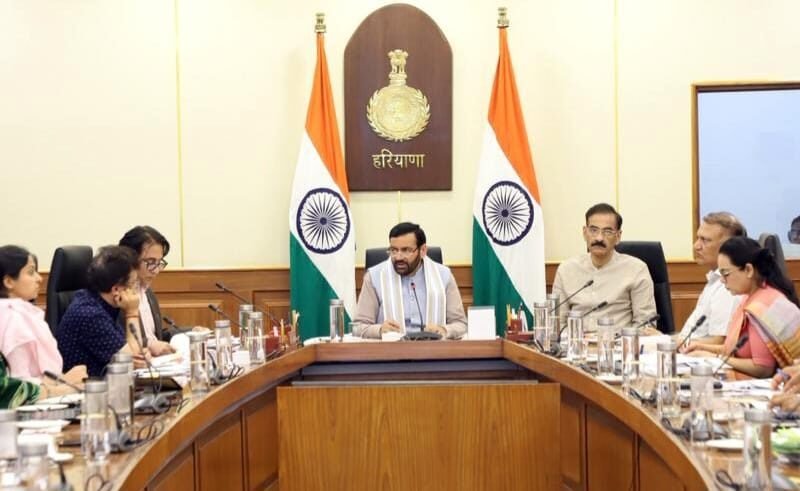
Chandigarh (Balwinder Singh): Haryana Chief Minister Nayab Singh Saini has declared that delivering clean drinking water and structured sewerage connectivity to every single household remains the apex infrastructure priority of the state government. Presiding over a high-profile review meeting of the Public Health Engineering Department at the Haryana Civil Secretariat on Saturday, Saini evaluated the department’s comprehensive five-year operational roadmap drafted under the overarching “Haryana Vision-2047” framework. The Chief Minister directed administrative secretaries to institutionalize concrete timelines for these civic initiatives and present a finalized execution strategy during the upcoming cabinet review.
The developmental mandate establishes a clear path forward for urban outskirts, newly regularized residential colonies, and the state’s welfare land allotments. Saini strictly instructed engineering teams to prioritize the installation of drinking water conduits, electrical sub-stations, sewage pipelines, and asphalt roads across all regularized urban pockets and the 100-square-yard plots allocated by the state to economically vulnerable families. To secure the primary supply chain, the Chief Minister approved a strategic policy shift to construct a specialized water treatment plant for every cluster touching a population threshold of 5,000 residents, alongside a mandate to transition remote water storage tanks entirely to canal-fed networks via underground pipelines to eliminate evaporation losses.
Emphasizing the transition toward smart, resource-efficient municipal governance on par with developed nations, Saini ordered the launch of an automated, 24-hour pressurized water supply pilot project in major metropolitan hubs like Gurugram. The smart-city blueprint mandates 100 percent household volumetric water metering to regulate consumption and check systemic leakages. Parallel directives were issued to expand sewage networks to manage long-term demographic expansions over the next fifty to sixty years, utilizing advanced robotic drilling machinery to replace outdated lines without causing surface traffic blockages. The state roadmap also integrates wastewater recycling targets, detailing a framework to channel treated sewage plant effluent directly to manufacturing zones and agricultural fields to preserve depleting groundwater tables.
To eliminate persistent inter-departmental lapses and public funds wastage, the Chief Minister proposed a radical structural overhaul of public works permissions. Noting that newly paved roads are frequently excavated shortly after completion by overlapping agencies laying fiber-optic cables, gas lines, or water mains, Saini directed the immediate establishment of a centralized regulatory authority or unified utility permit department. Moving forward, no civic body or private contractor will be legally permitted to excavate public pathways without securing a unified clearance from this newly proposed apex monitoring institution. The high-level planning session was attended by Chief Principal Secretary to the Chief Minister R.K. Khullar, Chief Secretary Anurag Rastogi, Principal Secretary Arun Gupta, and Public Health Engineering Department Commissioner-Secretary J. Ganesan, who briefed the bench on incorporating artificial intelligence analytical tools to process citizen grievances.
