

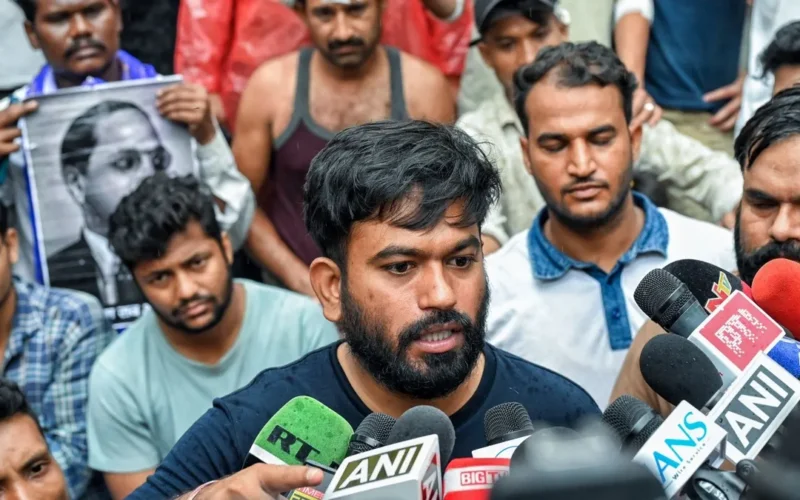
New Delhi (Rajeev Sharma): Political activist Abhijeet Dipke has questioned the government’s approach to restricting social media accounts, arguing that silencing online criticism will not resolve the concerns prompting people to speak out. His comments come amid a legal challenge over the blocking of an Instagram account associated with a campaign seeking the return of paper ballots in elections.
Dipke, an activist with the Cockroach Janata Party (CJP), shared his views on X on Wednesday. He argued that taking down posts and restricting accounts would not eliminate public dissatisfaction over issues such as governance, unemployment, examination paper leaks and infrastructure.
He also cautioned that such measures could undermine public confidence in the government rather than address the questions being raised by citizens.
Social Media Restrictions Spark Debate
The controversy has brought renewed attention to government orders directing social media platforms to remove content or restrict access to accounts in India.
Activists and political groups have raised concerns about the use of Section 69A of the Information Technology Act, which provides a legal framework for blocking online information in specified circumstances.
Critics argue that restrictions should be accompanied by appropriate safeguards and transparency, particularly when the affected accounts are used to discuss public affairs or organise peaceful demonstrations.
Dipke’s criticism reflects a broader disagreement over the balance between the government’s authority to regulate online content and citizens’ ability to express dissent through digital platforms.
Delhi High Court Issues Notices in Instagram Case
The debate gained momentum after the Delhi High Court sought a response from the Centre on a petition challenging the restriction of the Instagram handle @bring_back__ballot.
The account is linked to Mission Save Constitution and advocate Mehmood Pracha, the organisation’s national convenor. It was used to promote the ‘Bring Back Ballot’ initiative, which advocates replacing electronic voting machines with paper ballots.
According to the petition, the account became inaccessible to users in India on October 10, the day a demonstration was organised at Jantar Mantar in Delhi.
Justice Amit Mahajan issued notices to the Central Government and the concerned department, seeking their replies. The matter has been scheduled for the next hearing on November 6.
Advocate Amee Rana appeared for Meta Platforms and accepted notice. Central Government Standing Counsel Ashish Dixit accepted notice on behalf of the Ministry of Home Affairs, the Ministry of Electronics and Information Technology and the designated officer.
Petition Raises Questions Over Procedure
The petitioners, represented by advocate Nikhil Guliani, challenged the withholding of the account, claiming they were not given advance notice, an opportunity to present their case or a copy of the order directing the restriction.
Advocate Sanawar Chaudhary told the court that the account displayed a notification stating that access had been restricted in India in compliance with a legal request.
The petition also stated that the account was used to mobilise people for the October 10 protest under the slogan ‘EVM Hatao Desh Bachao’. According to the petitioners, the Delhi Police had been informed about the planned demonstration on October 9.
These claims form part of the ongoing legal proceedings, and the government’s response is awaited.
Focus on Transparency and Freedom of Expression
The dispute has placed questions about online censorship, government accountability and access to political expression back in the spotlight.
While authorities have legal powers to restrict certain online content, critics argue that transparency in the decision-making process is essential to maintaining public trust.
The High Court’s proceedings will provide an opportunity for the parties to present their positions on the restriction of the account. Until further developments emerge, the broader debate over social media regulation and freedom of expression is likely to continue.
