

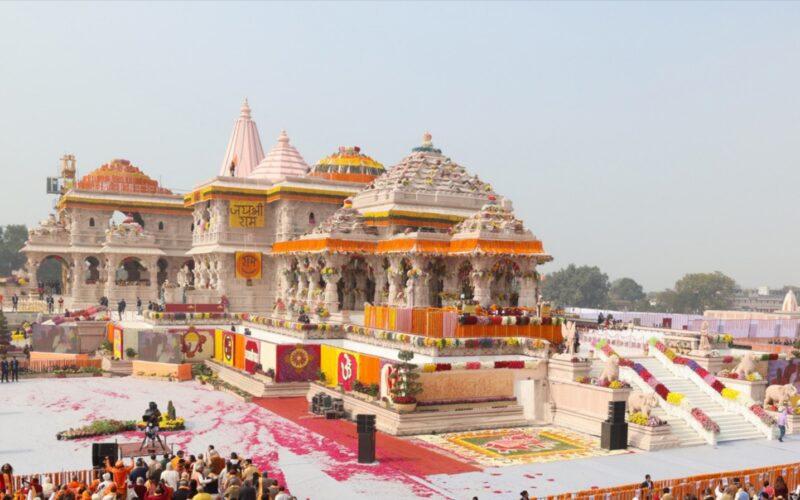
Ayodhya (Gurpreet Singh): A petition has been filed in the Supreme Court seeking an independent survey to establish whether the Ram Temple in Ayodhya has been constructed on the exact land and premises covered by the apex court’s 2019 verdict.
The plea, filed by the Shri Ram Janmabhoomi Case Trust, seeks the appointment of a court-monitored committee or commission comprising survey, revenue, archaeological and other technical experts to verify the temple site’s boundaries, coordinates, area and location.
The matter is scheduled to come up for hearing on November 2 before a Bench comprising Chief Justice Surya Kant, Justice Joymalya Bagchi and Justice V Mohana.
What Has the Petition Asked the Supreme Court to Verify?
The Trust has sought an independent assessment of whether the temple currently constructed and developed in Ayodhya stands on the precise premises adjudicated by the Supreme Court in its November 9, 2019, judgment.
It has asked the court to appoint qualified experts to examine the land and identify its exact boundaries and coordinates.
The petition further states that if the survey reveals any significant discrepancy between the land covered by the 2019 judgment and the premises on which the temple was constructed, the court should issue appropriate directions to ensure that its verdict is implemented faithfully.
The plea has also sought directions to the concerned authorities and the Shri Ram Janmabhoomi Teerth Kshetra Trust to preserve and submit original documents, maps, plans, surveys and other records related to the identification, demarcation and development of the temple premises.
What Did the Supreme Court Rule in the Ayodhya Land Dispute?
On November 9, 2019, a five-judge Constitution Bench of the Supreme Court delivered a unanimous verdict in the long-running Ayodhya land dispute.
The court directed that the 2.77 acres of disputed land be handed over to a trust to facilitate the construction of a Ram Temple. It also directed the Centre to allot an alternative five-acre plot to the Sunni Waqf Board at a prominent location in Ayodhya for the construction of a mosque.
The judgment followed 14 appeals challenging the Allahabad High Court’s 2010 ruling. The High Court had ordered the 2.77-acre disputed land to be divided equally among three parties: the Sunni Waqf Board, Nirmohi Akhara and Ram Lalla.
Petition Seeks Facilities for Devotees and Audit of Donations
Apart from the proposed land survey, the petition has raised issues concerning facilities for devotees visiting the temple from across India and abroad.
It has sought directions for the construction of additional facilities for visitors. The Trust has also requested that donations, offerings and receipts be digitised and displayed on a daily basis.
Another demand is for an annual audit of the temple-related accounts by the Comptroller and Auditor General of India (CAG), with the stated objective of preventing the misappropriation of funds.
These are demands made in the petition and are yet to be adjudicated by the Supreme Court.
Babri Masjid Demolition and the Long-Running Ayodhya Dispute
The Babri Masjid, a 16th-century mosque, stood at the disputed site in Ayodhya until it was demolished by Hindu kar sevaks on December 6, 1992. The demolition triggered communal violence in several parts of the country.
The legal dispute subsequently reached the Supreme Court through appeals against the Allahabad High Court’s 2010 judgment. The apex court’s unanimous verdict in 2019 paved the way for the construction of the Ram Temple and directed the allotment of alternative land for a mosque.
The latest petition has brought the identification and demarcation of the temple premises before the Supreme Court, with the matter listed for November 2.
