

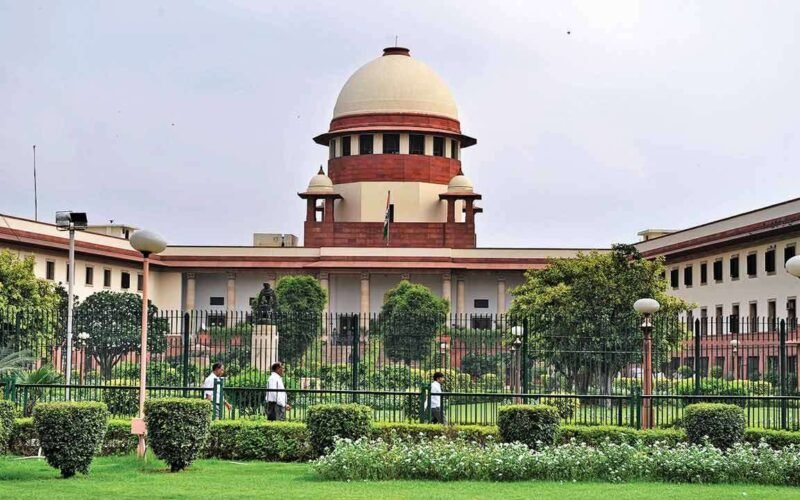
New Delhi (Gurpreet Singh): The Supreme Court has said that access to and use of the internet is a fundamental right for every individual, including children, under Articles 21 and 19(1)(a) of the Constitution. At the same time, the court has emphasised the need for proportionate safeguards to protect minors from harmful online content and interactions.
In its October 15 verdict, a Bench comprising Justice JB Pardiwala and Justice K Vinod Chandran said children’s safety and freedom should not be treated as competing interests.
“The safety of our children and their freedom are not at odds with each other. Our children are entitled to both,” the Bench observed.
Writing the judgment, Justice Pardiwala described the internet as a platform for ideas, creative expression and information. He noted that it can be particularly important for children living in remote areas, for whom it may provide access to learning resources and information. For children with special needs, online spaces can also offer opportunities to connect with people who share similar experiences.
The court said children enjoy fundamental rights irrespective of their age and that denying them internet access altogether would be inconsistent with their freedom of expression and other constitutional protections.
What Safeguards Has The Supreme Court Suggested For Children Online?
While recognising children’s right to access the internet, the Bench said this did not rule out age-based restrictions or protective measures.
The court suggested that social media platforms could adopt a dedicated “child mode” for accounts belonging to minors, with parental consent, guidance and oversight playing a greater role. It left the detailed framework and implementation arrangements to the Union government.
The suggested safeguards include:
- Private accounts by default: Children’s accounts could automatically have stricter privacy settings.
- Restrictions on unknown contacts: Platforms could limit messages and contact requests from unfamiliar adults.
- Moderation of content and advertisements: The material and advertising accessible to children could be subject to stronger controls.
- Parental consent and oversight: Platforms could introduce proportionate methods to verify parental consent, particularly for pre-teens.
The Bench said these measures should be designed in proportion to the objective of protecting children. It did not prescribe a final, comprehensive set of rules, instead leaving the modalities to the Union government.
The court also clarified that its observations would not prevent the government from restricting children’s access to specific categories of content or services that are inherently harmful, including adult-content websites.
Why Did The Supreme Court Address Children’s Internet Rights?
The observations came while the court was hearing a plea filed by Just Rights for Children Alliance. The petition alleged that online intermediaries had failed to adequately address Child Sexual Exploitation and Abuse Material (CSEAM), despite the Supreme Court’s September 2024 verdict on the issue.
The case raised questions about how children can be protected from online exploitation without denying them access to the internet and its educational, social and expressive benefits.
The Bench said protective measures should focus on harmful material and those responsible for creating, circulating, selling or seeking it out, as well as intermediaries that fail to detect and remove it.
The court cautioned against placing the burden of such failures on children by excluding them from the internet.
In its observations, the Bench stressed that the wrongdoing in cases involving CSEAM lies with the perpetrators and any intermediaries that fail to fulfil their responsibilities—not with the children who are victims of abuse.
Can The Government Restrict Children’s Access To Certain Online Content?
Yes. The court explicitly clarified that recognising internet access as a fundamental right does not prevent the Union government from restricting access to specific categories of services or content that are inherently harmful to children.
This distinction is central to the judgment: children’s constitutional freedoms must be respected, but those freedoms can coexist with reasonable safeguards against exploitation and inappropriate content.
The court’s suggested approach places emphasis on safer platform design, parental involvement and stronger action against harmful material rather than imposing a blanket exclusion of children from the internet.
The detailed rules, including how parental consent may be verified and how child-specific social media protections could operate, remain matters for the Union government to consider.
The verdict thus highlights the need to balance children’s access to information, education and expression with effective measures against online abuse and exploitation.
