

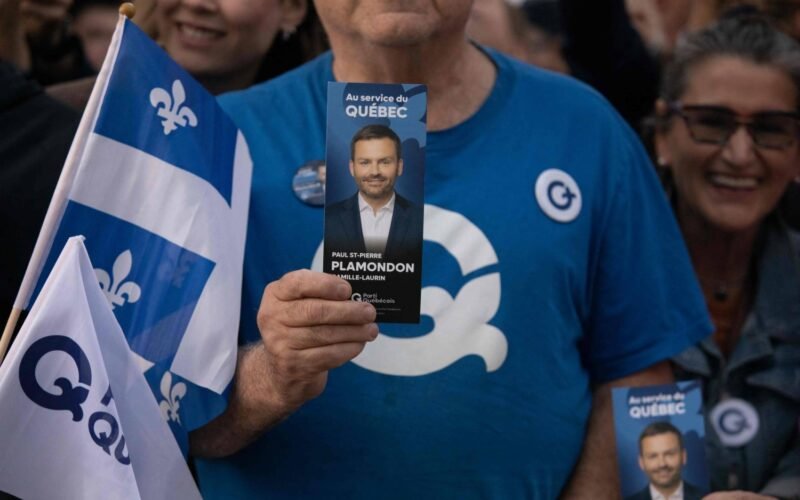
MONTREAL (Rajeev Sharma): Quebec has handed a major political victory to the separatist movement, with the Parti Québécois (PQ) emerging as the province’s leading force and Paul St-Pierre Plamondon set to become the next premier.
The result marks a significant shift in Quebec politics and presents a fresh challenge for Prime Minister Mark Carney as his federal government deals with economic pressure, tensions with the United States and renewed questions about Canada’s future as a united country.
Despite winning the election, the PQ did not secure enough seats for a majority government. Its share of the popular vote was reported at roughly 30 percent, with divisions among parties supporting continued Canadian federalism helping the separatists emerge on top.
Celebrations in Montreal quickly turned into a show of support for Quebec independence, with crowds at the PQ victory gathering chanting the familiar slogan that Quebec should become a country.
Plamondon, a 49-year-old lawyer widely known as PSPP, has spent years rebuilding the separatist movement after the PQ remained out of government for more than a decade. His victory now puts the question of Quebec sovereignty back at the centre of Canada’s political debate.
Carney congratulates Quebec’s next premier
Carney offered congratulations to Plamondon following the result, emphasizing that Quebec’s prosperity remains closely connected to Canada’s broader strength.
The election outcome, however, does not necessarily signal a direct rejection of the federal government’s approach to US President Donald Trump. Carney remains relatively popular in Quebec, while Trump’s tariff measures and repeated rhetoric about Canada have generated widespread concern across the country.
Instead, the PQ’s electoral comeback has been driven largely by provincial issues, including the rising cost of living, concerns over immigration and efforts to strengthen the French language.
Plamondon has repeatedly said he intends to give Quebecers another opportunity to vote on independence. He has nevertheless ruled out holding such a referendum while Trump remains in the White House, arguing that Quebecers should be able to consider the issue without outside political pressure.
Under his proposed timeline, a referendum would not take place before 2029.
Independence debate remains divisive
Quebec has already held two major referendums on sovereignty.
The first, in 1980, resulted in a clear victory for those who wanted Quebec to remain part of Canada. Fifteen years later, the second vote produced one of the closest political contests in Canadian history. In 1995, the federalist side prevailed by only a narrow margin, with 50.58 percent voting against independence.
Current public opinion suggests the separatist cause still lacks majority support, with surveys indicating that roughly three in ten Quebecers favour independence.
For younger voters, however, the debate remains closely connected to concerns about Canada’s position in an increasingly uncertain world.
Nineteen-year-old first-time voter Alexia Gomez said she opposed another independence referendum, arguing that an independent Quebec could face greater economic, political and military vulnerability.
Others expressed concern about the PQ’s positions on immigration. The party has advocated reducing immigration levels, with particular emphasis on limiting the arrival of people who do not speak French.
Monarchy could become another flashpoint
While Quebec sovereignty remains the most consequential issue surrounding the new government, Plamondon could find broader public support for another proposal: reducing the role of Canada’s monarchy.
Canada remains a constitutional monarchy, with King Charles III serving as head of state and represented federally by the governor general. The monarchy is also represented in Quebec through the province’s lieutenant governor.
Plamondon has criticized the institution and suggested that a PQ government could stop funding the lieutenant governor’s office, describing it as an outdated and unnecessary expense.
His position reflects widespread skepticism toward the monarchy in Quebec. A 2025 Leger survey found that 87 percent of Quebec respondents said they had no attachment to the British monarchy, while only 31 percent held a favourable view of King Charles.
The PQ’s return to power therefore opens several new political fronts — from the future of Quebec within Canada to immigration, language policy and the province’s relationship with the Crown.
For Ottawa, the challenge will be to maintain national cohesion while navigating a new Quebec government that has placed the question of sovereignty firmly back on the political agenda.
