

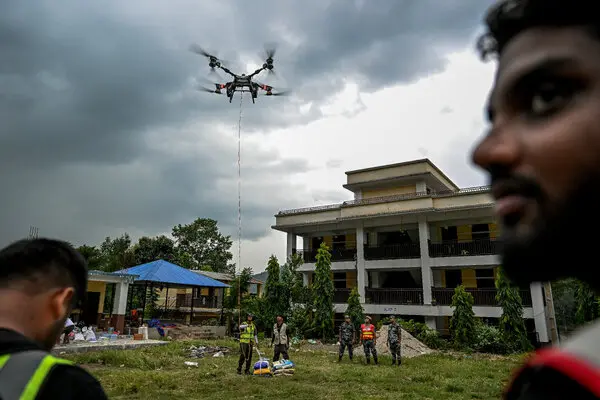
Kathmandu (Rajeev Sharma): As devastating floods continue to disrupt parts of Nepal, drones are taking on an increasingly important role in rescue and relief operations, reaching places where damaged roads, collapsed bridges and dangerous terrain have prevented rescuers from travelling safely.
In one of the most unusual missions reported this week, drones were used to transport seven bodies from Devighat-3 in Nuwakot to Devighat-5. The area was considered too difficult and hazardous for rescue teams to access directly.
The operation involved personnel from the Nepal Police, Nepal Army and drone manufacturer GarudX, highlighting how unmanned aircraft are being incorporated into emergency response efforts.
Drones deliver essential supplies
The technology is also being used to provide food, medicine and other necessities to communities cut off by the floods.
In Devighat-3, an AI-assisted drone flew over stranded residents and used a loudspeaker to ask whether they needed water, food or medicine. People could respond by raising their hands, allowing operators to assess the needs of isolated communities before sending supplies.
According to drone operators, at least 1.5 tonnes of emergency supplies were delivered to affected areas over a three-day period.
The approach has proved particularly useful in locations where floodwaters have separated villages from the main road network. Residents can also communicate their location by displaying a phone number or address on a sign or writing it in the mud for drone teams to identify.
Technology reaches dangerous areas
Drones have also been deployed in search operations. One aircraft was sent inside a tunnel at the Upper Trishuli-1 hydropower project after floods raised concerns about workers believed to be trapped there.
The drone operators reported seeing water and rocks inside the tunnel but found no indication of survivors during the operation.
The Independent Power Producers’ Association of Nepal has reported that around 900 workers are missing from various hydropower projects along the Trishuli and Bhote Koshi rivers.
Nepal builds its own drone expertise
Nepal’s use of drones for disaster management is not entirely new. The country’s drone capabilities expanded significantly following the 2015 earthquake, when the technology was used for damage assessment and recovery work.
Since then, local companies and young Nepali drone operators have increasingly developed and deployed the technology themselves. Nepali firms have even provided drone-related services in Bhutan for assessing risks from multiple natural hazards.
There are still practical challenges, including limited payload capacity, flight range and the effects of severe weather. Even so, operators say drones can offer a relatively affordable alternative to helicopters when transporting essential supplies to isolated locations.
For a country frequently exposed to floods, landslides, earthquakes and other natural hazards, the growing use of locally operated drones could become an important part of future emergency response.
As damaged infrastructure continues to limit access to some communities, these small unmanned aircraft are proving capable of doing something much bigger: delivering help, gathering information and reaching places that remain too dangerous for people.
