

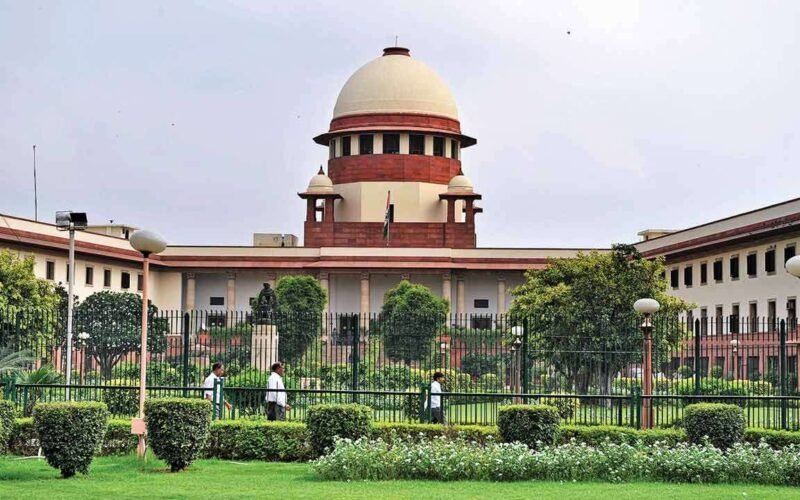
New Delhi (Gurpreet Singh): A nine-judge Constitution Bench of the Supreme Court of India, led by Chief Justice Surya Kant, has delivered a 5:4 majority verdict modifying the expansive definition of “industry” established in the landmark 1978 judgment Bangalore Water Supply & Sewerage Board v. R. Rajappa. The bench held that while the core framework of the “triple test” authored by Justice V.R. Krishna Iyer has stood the test of time, certain elements and guidelines required refinement. The court ruled that this modified formulation applies prospectively and will not affect pending disputes, which will continue to be governed under the 1978 precedent under the repealed Industrial Disputes Act, 1947.
The majority decision was backed by Chief Justice Surya Kant and Justices Satish Chandra Sharma, Alok Aradhe, and Vipul M. Pancholi, alongside Justice P.S. Narasimha, who authored a separate concurring opinion. In contrast, Justices B.V. Nagarathna, Dipankar Datta, Ujjal Bhuyan, and Joymalya Bagchi dissented. While refining the triple test for future interpretation, the bench explicitly refrained from examining the statutory definition of “industry” under the Industrial Relations Code, 2020.
The original 1978 ruling had defined an industry as any systematic activity organized by cooperation between employers and employees to produce or distribute goods and services, irrespective of profit motive, bringing educational institutions, hospitals, clubs, and state welfare departments within labour dispute mechanisms. The central government challenged this sweeping ambit, with Attorney General R. Venkataramani arguing that indiscriminate application blurred sovereign administrative functions and charitable state welfare initiatives with commercial enterprise.
The reference originated from conflicting judicial views in 1996 and 2001 regarding whether government departments, such as Social Forestry, constituted an industry. This led a five-judge Constitution Bench in 2005 to refer the matter to a larger bench, followed by a seven-judge bench in 2017 directing the case to the nine-judge bench due to its wide-ranging implications for labour law jurisprudence and public administration.
