

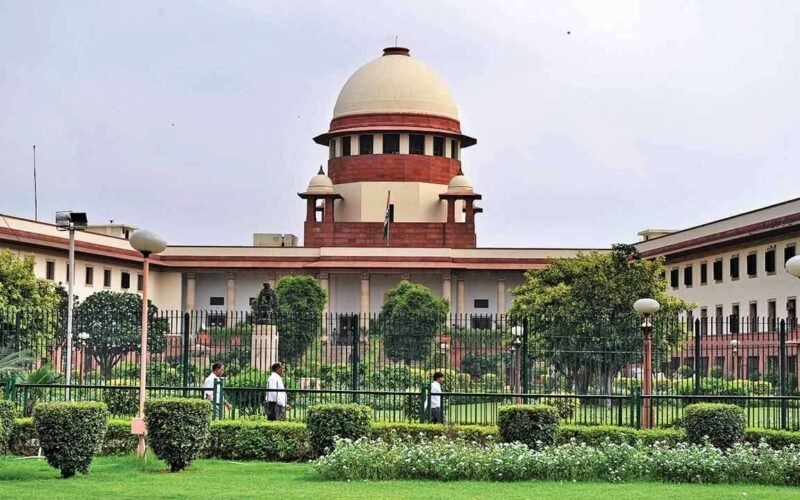
New Delhi (Gurpreet Singh): The Supreme Court of India has declined to grant an interim stay on the Central Board of Secondary Education’s newly implemented three-language policy. The controversial mandate requires Class 9 students to study three languages, which must include at least two native Indian languages, starting from the current 2026-27 academic session. A three-judge bench led by Chief Justice of India Surya Kant, along with Justices Joymalya Bagchi and V. Mohana, issued fresh notices to the Central Government, the CBSE, and the National Council of Educational Research and Training. While refusing to pause the rollout, Chief Justice Surya Kant colloquially remarked that the learning of a language never goes to waste, deferring a detailed hearing on the legal challenges to next week.
The legal challenge stems from a batch of petitions filed by concerned groups, including Yashica Bhandari Jain, who argue that the sudden policy shift has triggered immense academic disruption and structural confusion. Senior advocates representing the petitioners, including Anand Grover, Mukul Rohatgi, Shyam Divan, and Gopal Sankaranarayanan, argued that the policy advances the implementation timeline originally slated by the National Education Policy 2020 for 2030. The legal counsel contended that the CBSE lacks statutory authority to independently enforce such norms, a power reserved for the NCERT. They also highlighted critical infrastructure deficits, pointing out that schools face severe shortages of qualified native language instructors and that the NCERT website currently hosts textbooks for only a few of the 22 scheduled regional languages. Furthermore, advocates questioned the rationale behind classifying English as a non-native language, warning that students who have studied foreign languages like French or German since the primary grades are now being unfairly burdened with learning a completely new regional language, such as Tamil or Sanskrit, just a year before their crucial board evaluations.
Defending the educational overhaul, the Union Ministry of Education, the CBSE, and the NCERT filed separate affidavits urging the apex court to dismiss the petitions. The central authorities asserted that the policy framework serves a legitimate public objective by fostering multilingualism and national integration. To mitigate anxieties, the CBSE informed the court that roughly 47 per cent of its 28,800 affiliated schools already comply with the policy, and nearly all have at least one Indian language teacher on staff. The board clarified that it has adopted a highly practical transition strategy, allowing schools to utilize retired teachers and qualified postgraduates to fill immediate faculty gaps. Crucially, the CBSE highlighted that the newly added third language will not feature a stressful external board examination at the Class 10 level. Instead, evaluation will be entirely internal and school-based, with flexible provisions for re-assessment to ensure that no student is held back or denied their passing certificate due to language learning.
