

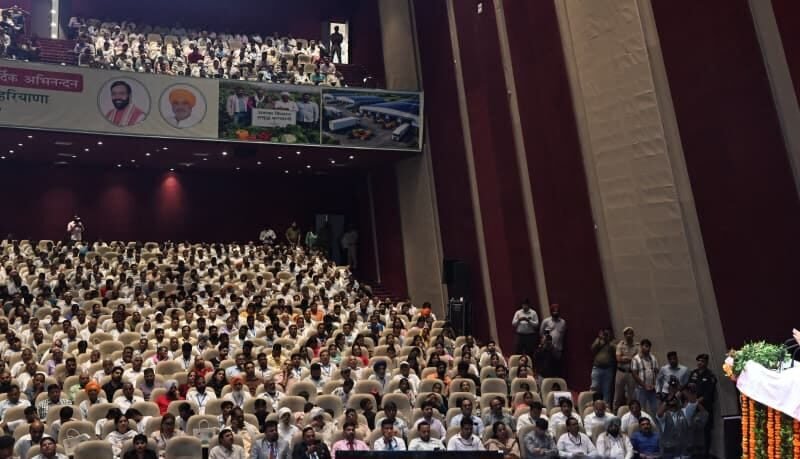
Chandigarh (Balwinder Singh): Haryana Chief Minister Nayab Singh Saini announced that the state is poised to spearhead a major transformation in agriculture, mirroring the impact of the historical Green Revolution through a new focus on horticulture and agribusiness. Speaking at a World Environment Day event in Panchkula, Chief Minister Saini launched the ₹2,738 crore Sustainable Horticulture Promotion Project, funded by the Japan International Cooperation Agency (JAICA). He also laid the foundation stone for the Haryana Agribusiness and Cold Chain Centre, aiming to position the state as a national leader in food processing, agri-exports, and eco-friendly farming.
Accompanied by Agriculture and Farmers’ Welfare Minister Shyam Singh Rana, the Chief Minister detailed how the financial allocation will systematically fortify the agricultural value chain from farm to market. The mega project includes the creation of 400 horticulture clusters, the organization of 500 farmer producer groups, and the construction of 402 pack houses alongside 4 specialized lead pack houses. To ease distribution bottlenecks, the infrastructure will incorporate 3 fulfilment centres and 44 retail outlets, alongside installing 1,000 rainwater harvesting structures to bring 65,000 acres of arable land under modern micro-irrigation networks.
The baseline technology within this network will utilize advanced digital systems, including artificial intelligence, real-time crop monitoring, geospatial mapping, internet of plants, and online marketing channels. Furthermore, a scientific partnership established between Maharana Pratap Horticultural University in Karnal and Kochi University in Japan will ensure that international research and crop technologies are directly transferred to local growers. Chief Minister Saini challenged the state’s youth to leverage these systems to become employment creators via food startups rather than employment seekers, while stressing that expanding the financial agency of women in mushroom cultivation and packaging remains central to regional development.
The administration expects the newly founded Haryana Agribusiness and Cold Chain Centre to serve as a world-class training hub benefiting over 3 lakh farmers. The facility is designed to improve supply chain efficiency by over 75 per cent and curb post-harvest losses by 10 to 15 per cent through compliance with global standards like Good Agricultural Practices (GAP) and Hazard Analysis Critical Control Point (HACCP). Highlighting long-standing Indo-Japanese economic ties, the Chief Minister expressed gratitude to JAICA representatives, noting that Haryana already hosts 394 Japanese industrial units and over 600 corporate establishments.
Turning to ecological conservation, the leaders participated in the prime minister’s ‘Ek Ped Maa Ke Naam’ plantation drive and outlined aggressive climate remediation goals. To combat waterlogging and land salinity, the state will implement bio-drainage technologies across 1,000 hectares of degraded land this year, while constructing 25 new water storage dams and restoring 25 legacy reservoirs across the Shivalik and Aravalli ranges. To lower vehicular carbon emissions, Haryana plans to add 780 new electric buses to its public transport fleet by the end of 2026. Industrial pollution controls are also being expanded, with Online Continuous Emission Monitoring Systems (OCEMS) active in 1,308 out of 1,349 targeted NCR units, alongside the construction of 6 new sewage treatment plants and 8 common effluent treatment plants to preserve the Yamuna river basin.
