

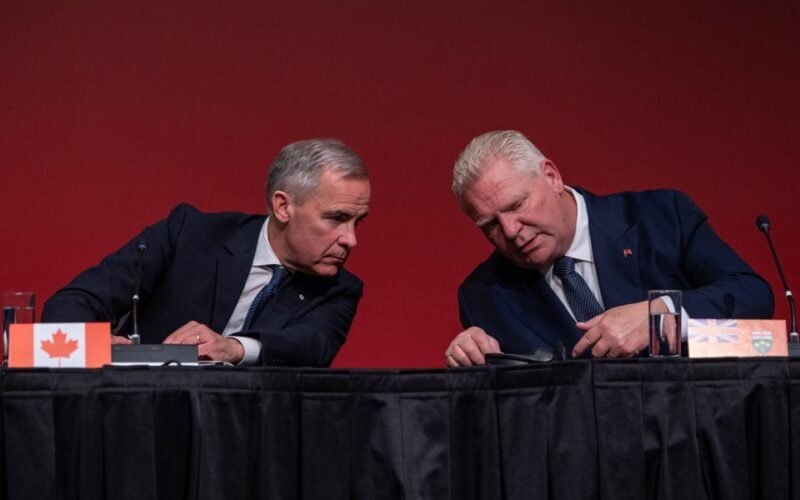
Ontario (Rajeev Sharma): Ontario Premier Doug Ford has drawn a firm line on Canada’s electric vehicle policy toward China, saying the only scenario in which tariffs should be reconsidered is if Chinese automakers commit to building vehicles in Ontario and employing unionised Canadian workers.
Ford made the remarks Thursday while speaking at a separate news event, days before Prime Minister Mark Carney is set to travel to Beijing for high-level talks with Chinese leadership. The upcoming visit will mark the first time a Canadian prime minister has travelled to China since 2017 and comes at a moment when Ottawa is reassessing its global trade relationships amid ongoing friction with the United States.
Carney has indicated that his government is open to reviewing the previous Liberal administration’s decision to impose steep import duties on electric vehicles and certain hybrids from China. Those measures — which include 100 per cent tariffs on EVs as well as levies on Chinese-made trucks, buses and delivery vans — prompted swift retaliation from Beijing. China responded by placing a 100 per cent tariff on Canadian canola oil and meal, along with a 75.8 per cent duty on canola seed.
Chinese officials have since suggested that those agricultural tariffs could be lifted if Canada removes its restrictions on Chinese electric vehicles.
Ford, however, said Ottawa should not retreat from its current position unless China is willing to invest directly in Canada’s manufacturing base.
“We shouldn’t be opening the door to vehicles being shipped in while our own workers are left behind,” Ford said, adding that any compromise would have to involve a major production facility located in Ontario and staffed by members of Unifor. “If they want to build here and create good jobs, then there’s a conversation to be had. Otherwise, no.”
The premier has long argued that tariffs on Chinese EVs are necessary to protect domestic auto manufacturing and to ensure fair competition, particularly as Canada aligns its trade strategy with the United States. Washington was the first to impose heavy duties on Chinese electric vehicles, a move Ford has said helps Canada maintain leverage in negotiations with its largest trading partner.
Ford reiterated that position this week, while suggesting that local production by Chinese firms could also pressure North American automakers to remain competitive in the Canadian market.
The broader trade landscape remains uncertain. Canada is expected to enter a formal review of the Canada–United States–Mexico Agreement (CUSMA) later this year, following the pause of separate bilateral talks with the Trump administration. Prime Minister Carney has said that unresolved issues — including US tariffs on Canadian steel, aluminum and lumber — are now likely to be addressed within the CUSMA framework.
Ford said provincial leaders are united in supporting the federal government as those negotiations approach, while acknowledging the unpredictability of US politics.
“There’s pressure building south of the border,” he said, expressing confidence that Ottawa and the provinces will be able to secure the strongest possible outcome for Canada.
Carney’s visit to China is scheduled to take place from January 13 to 17.
