

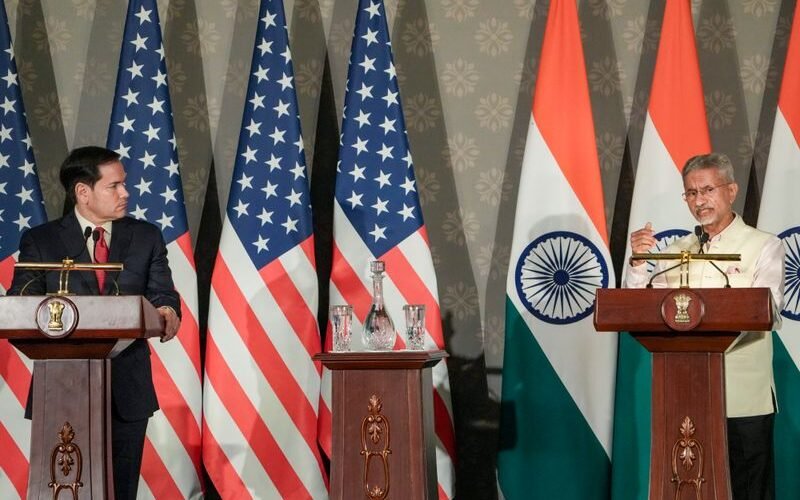
New Delhi (Gurpreet Singh): The United States declared that its bilateral relationship with Islamabad does not come at the cost of its fundamental alliance with India, addressing regional apprehensions regarding recent diplomatic shifts. Speaking during a joint press briefing in New Delhi alongside External Affairs Minister S Jaishankar, US Secretary of State Marco Rubio characterized India as one of America’s most critical strategic partners globally. The high-profile statement comes during Rubio’s four-day official visit to the Indian capital, aimed at reinforcing the core parameters of the transnational partnership.
Responding directly to queries regarding New Delhi’s growing unease over the apparent closeness between Washington and Islamabad over the past year, Secretary Rubio clarified that the United States does not view its engagements with other nations through a zero-sum lens. He framed America’s ongoing cooperation with Pakistan as engagement at a tactical level, noting that maintaining diverse operational relationships is standard practice for responsible nation-states, including India. The diplomatic reassurance seeks to decouple Washington’s broader Indo-Pacific strategy from its localized, functional channels in South Asia.
The strategic clarification follows a period of heightened diplomatic activity between US President Donald Trump and Pakistan’s Army Chief, Field Marshal General Asim Munir, which had drawn close monitoring from Indian security analysts. Over the past twelve months, Islamabad emerged as a primary diplomatic backchannel between Washington and Tehran during the intense US-Iran conflict. This unique operational role was underscored earlier in 2025 when President Trump hosted Field Marshal Munir for a private White House luncheon, marking a rare diplomatic gesture extended to a Pakistani military chief without the presence of civilian political leadership.
Beyond high-level diplomatic access, the shifting dynamics have included symbolic gestures and economic offers, with the Pakistani military leadership attending major US military functions and proposing American access to critical mining and rare earth element projects in Balochistan. Concurrently, Pakistani Prime Minister Shehbaz Sharif has publically aligned with the US administration’s regional objectives, even nominating President Trump for the Nobel Peace Prize. Despite these complex transactional developments, Secretary Rubio’s explicit declarations in New Delhi reinforce the narrative that Washington views its comprehensive strategic alliance with India as an entirely separate, top-tier geopolitical priority.
