

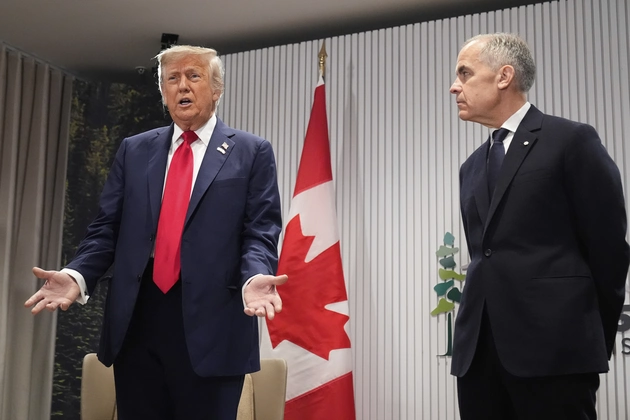
Washington: US President Donald Trump’s decision to refer to Lake Ontario as “Lake America” for US federal purposes has opened another front in the increasingly tense relationship between the United States and Canada.
The announcement concerns one of the five Great Lakes shared by the two countries and comes at a time when Ottawa and Washington are already locked in disputes over tariffs and trade.
Under the US move, federal agencies in America can use the new name. However, the decision does not compel Canada, foreign governments, international organisations or state authorities to abandon the name Lake Ontario.
Ottawa Stands by Historic Name
Canada has rejected the change, with Prime Minister Mark Carney making clear that the country will continue to use the lake’s established name.
Carney pointed to the long history of the name, noting that it existed centuries before the formation of modern Canada and even predates the United States’ Declaration of Independence.
The Canadian prime minister also highlighted the Indigenous roots of the name. “Ontario” is derived from the Wendat term Ontarí’io, which has historically been associated with the lake’s size and beauty.
New York Won’t Follow Washington’s Lead
The response has also been notable on the US side of the border.
New York, which shares a shoreline with Lake Ontario, has indicated that it will retain the traditional name. This means that the federal government’s terminology could differ from that used by the state government and residents of New York.
The development has effectively created a naming dispute over a body of water that has long served as a geographic link between the two countries.
Name Change Comes Amid Trade Dispute
Trump’s announcement comes as relations between Washington and Ottawa remain under pressure.
The two neighbours have been engaged in a series of trade disagreements, with tariffs affecting significant volumes of goods exchanged between the countries. The economic dispute has already become a major issue in bilateral relations.
Against this backdrop, the Lake Ontario naming decision has acquired political significance, particularly in Canada, where officials have stressed the historical continuity of the lake’s established name.
What the US Order Actually Changes
Despite the attention surrounding the announcement, the practical scope of the decision is limited.
The new terminology applies to US federal government usage. It does not have the power to determine what Canada calls the lake, nor does it automatically change terminology used by international organisations or other jurisdictions.
As a result, “Lake America” may appear in US federal references while Lake Ontario continues to be used in Canada and by authorities in New York.
The disagreement over the lake’s name has therefore become the latest symbol of the wider friction between the two North American neighbours, with both sides showing little sign of giving up their respective positions.
