

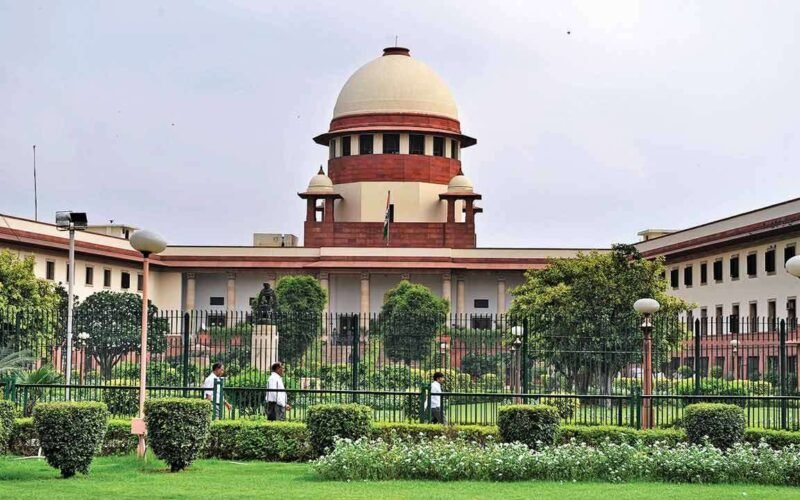
New Delhi (Rajeev Sharma): The Supreme Court on Monday directed the Central Bureau of Investigation (CBI) not to take coercive action against individuals linked to the Punjab Government in a case involving allegations of corruption against senior officials. However, the court made it clear that the FIR would remain in place and that the investigation itself had not been stayed.
A Bench comprising Justices MM Sundresh and PB Varale passed the order while hearing a petition filed by the Punjab Government challenging a direction issued by the Punjab and Haryana High Court for a CBI investigation into the allegations.
The apex court issued notices to the Centre, the CBI, the Enforcement Directorate (ED) and other parties concerned. Clarifying the scope of its order, the Bench stated that it was not staying the FIR but had directed that no coercive steps be taken against the individuals concerned.
Senior advocates Vikas Singh and Sidharth Luthra represented the Punjab Government before the court.
Dispute Over High Court-Ordered Investigation
The state government approached the Supreme Court last Monday, contesting the High Court’s direction for the CBI to investigate corruption allegations involving people linked to the state administration. The agency had also been asked to submit its findings within two months.
The case originated from a petition filed by advocate Nikhil Saraf, who raised allegations of bribery in government transfers and claims that money was being paid to secure favourable policy decisions.
The petitioner argued that the allegations warranted an independent investigation, raising concerns about the functioning of the state government. It was also submitted that no effective action had been taken despite communications reportedly sent by the ED to the Aam Aadmi Party-led government.
The High Court had further instructed the Punjab Police and the state government to hand over all documents connected with the matter to the CBI.
State Challenges Legal Basis of High Court Order
In its appeal, the Punjab Government questioned the legal reasoning behind the High Court’s decision, particularly its interpretation of information shared under Section 66(2) of the Prevention of Money Laundering Act (PMLA).
The state argued that the provision could not automatically be treated as requiring the registration of an FIR. In support of its position, the government referred to the Supreme Court’s 2022 judgment in the Vijay Madanlal Choudhary case.
The petition also raised objections to the direction to investigate decisions taken by public servants concerning transfers, tenders and policy matters. According to the state, such an inquiry would have to comply with the prior-approval requirement under Section 17A of the Prevention of Corruption Act.
The government further challenged the High Court’s criticism of the investigating agency for not involving a serving officer, arguing that the officer could not legally be subjected to an inquiry without the approval required under the law.
FIR Remains in Force
The Supreme Court’s interim direction provides protection against coercive measures while the matter is considered further. It does not, however, amount to the cancellation of the FIR or a halt to the CBI investigation.
The notices issued by the Bench will allow the Centre, the investigating agencies and the other respondents to present their positions in the case.
The legal dispute centres on the scope of an independent corruption investigation, the safeguards applicable to public servants and the extent to which a state government can challenge a probe ordered by a High Court. The next developments will depend on the responses filed by the parties and the Supreme Court’s subsequent consideration of the matter.
