

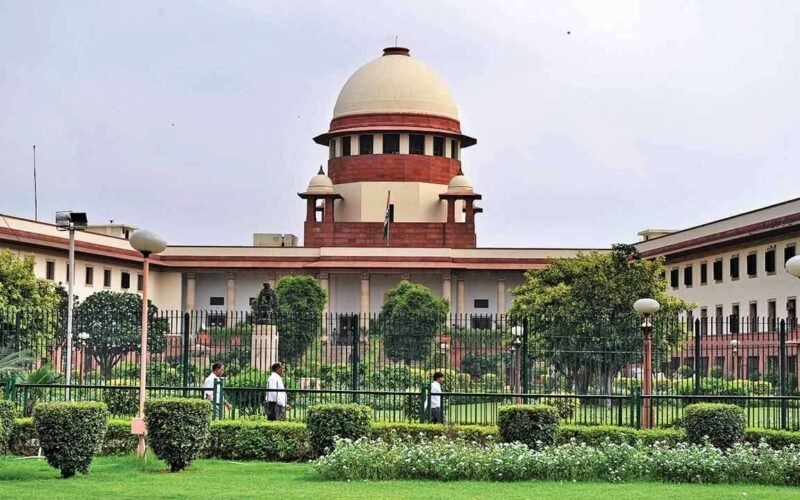
New Delhi (Gurpreet Singh): The Supreme Court quashed the Union Government’s 2021 Office Memorandum (OM), which established a continuous administrative route for granting retrospective environmental clearances (ECs) to projects that began operations without prior regulatory approval. Declaring the executive order impermissible under law, a three-judge Bench headed by Chief Justice of India Surya Kant ruled that the directive failed the tests of proportionality and reasonableness, while infringing upon fundamental rights under Articles 14 and 21 of the Constitution. The court emphasized that mandatory prior environmental clearances remain the foundation of India’s environmental regulatory framework and that project proponents cannot illegally commence construction before seeking clearance.
Delivering a unanimous verdict alongside Justice Joymalya Bagchi and Justice Vipul M. Pancholi, the Bench clarified that the judgment will take prospective effect. This safeguard ensures that environmental clearances previously granted under the 2017 Notification and 2021 OM will remain valid unless individually challenged on their legal merits. The ruling protects several major infrastructure initiatives, including a medical institute in Odisha, a greenfield airport in Karnataka, and essential effluent treatment infrastructure, from punitive actions or demolition.
While barring the Union Government from using routine executive orders to bypass prior approval mandates under the 2006 Notification, the Supreme Court recognized specific statutory exceptions. The Bench held that the Centre retains limited authority under Section 3 of the Environment (Protection) Act, 1986, to introduce narrowly tailored, time-bound amnesty schemes through valid statutory notifications when compelling public interest demands it. Additionally, the court highlighted its extraordinary jurisdiction under Article 142 of the Constitution to grant ex-post-facto clearances in deserving cases. Following the verdict, the Registry was instructed to de-tag the batch of review petitions and list them for further procedural hearings.
