

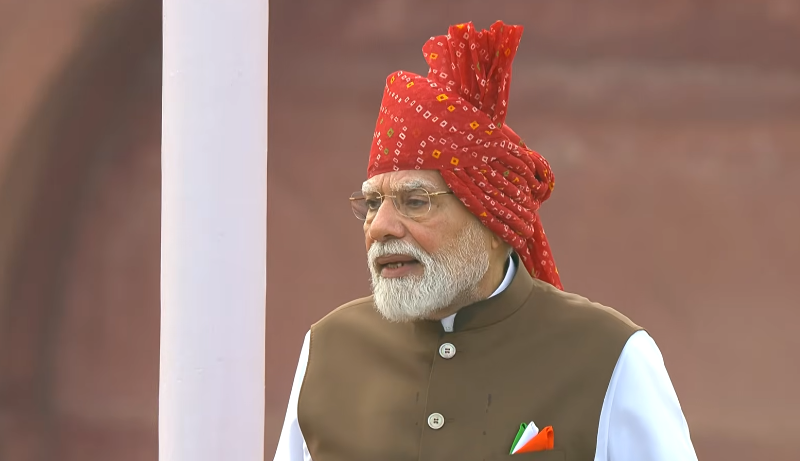
New Delhi (Rajeev Sharma): Prime Minister Narendra Modi, in his Independence Day address from the Red Fort, laid out an ambitious vision for India’s journey towards becoming a developed nation by 2047, with a strong emphasis on self-reliance, economic reforms, energy security and greater participation of the country’s youth.
Against the backdrop of recent global disruptions, Modi said India had demonstrated resilience through the pandemic, wars and supply-side uncertainties. He argued that the lessons from these crises had reinforced the need for the country to build stronger domestic capabilities and reduce strategic dependence on overseas markets.
The Prime Minister said India now needs to achieve in the next five to seven years what had remained unfinished over several decades, calling for a change in both the government’s approach and the country’s collective mindset.
Manufacturing to become a major growth engine
Modi identified manufacturing as one of the key engines that can propel India towards the 2047 goal.
He said Indian manufacturers would have to concentrate on cost, quality and scale if the country is to establish itself as a competitive global production hub. At the same time, he stressed that quality cannot be compromised because it would ultimately determine the strength of India’s global brand.
Food processing was another area highlighted by the Prime Minister, particularly in view of India’s growing access to overseas markets through trade agreements.
Technology, innovation and digital capabilities were also placed among the sectors that would shape India’s next phase of economic expansion.
Farmer support amid global price pressures
The Prime Minister highlighted government intervention in the fertiliser market to underline the importance of protecting farmers from international price shocks.
He said a sack of urea that costs significantly more in the international market is being made available to Indian farmers at about Rs 300, with the government absorbing the difference.
Similarly, Modi pointed to the continued availability of DAP fertiliser at Rs 1,350, despite higher global prices.
He said such measures were aimed at ensuring that international disruptions do not translate into an additional financial burden for Indian farmers.
Energy independence remains a priority
Energy security emerged as another major theme of the speech.
PM Modi said India was working towards achieving 100 GW of nuclear power capacity by 2047 and planned to commission five new nuclear reactors during the current decade.
He also referred to India’s progress in fast breeder nuclear technology, describing the development as an important milestone in the country’s pursuit of greater energy and fuel security.
The Prime Minister said India must continue exploring alternative sources of energy while improving the efficiency with which existing resources are used.
India opens more areas for offshore exploration
Turning to domestic resource exploration, Modi said India had previously restricted large parts of its coastline from exploration but was now opening those areas for greater activity.
He said the country had begun looking towards its deep-sea resources as part of efforts to reduce dependence on imported crude oil.
The Prime Minister cited the Samudra Manthan initiative and said an allocation of Rs 85,000 crore had recently been made to accelerate work in this area.
Semiconductor push gains momentum
PM Modi also pointed to the semiconductor industry as an important component of India’s self-reliance strategy.
He said three semiconductor facilities had already begun production and that their output was also being exported.
According to the Prime Minister, several more semiconductor plants are expected to become operational over the next seven to eight years, strengthening India’s position in a sector crucial to electronics, medical equipment, automobiles and other modern industries.
Gas connectivity expands across cities
The speech also highlighted the rapid expansion of India’s piped natural gas network.
PM Modi said only around 70 cities had access to piped gas distribution before 2014, while the network has now expanded to roughly 700 cities.
He presented the expansion as an example of the scale at which India’s infrastructure and energy systems have developed over the past decade.
MSMEs urged to look beyond domestic markets
With India entering into new trade agreements, the Prime Minister asked the country’s MSMEs to view international markets as an opportunity rather than a challenge.
He said Indian businesses must be ready to take advantage of the access created through these agreements and strengthen their ability to compete globally.
Modi also referred to India’s stable political system, democratic institutions and judicial framework as factors that provide confidence for businesses and investors.
Youth to play decisive role in 2047 journey
The Prime Minister said India’s youth would have a central role in achieving the developed-nation target.
He described young Indians as the principal beneficiaries of a Viksit Bharat and stressed the importance of creating opportunities for them in areas ranging from manufacturing and technology to entrepreneurship and innovation.
From dependence to confidence
A recurring message throughout the address was the need to move away from dependence and develop confidence in India’s own capabilities.
Modi said the country had once been held back by an attitude of accepting delays and shortcomings, but argued that India had gained new momentum over the past decade.
He recalled the period when India was described internationally as part of the “Fragile Five” and contrasted it with what he described as the country’s present trajectory.
2047 vision at the heart of the address
The Prime Minister concluded his broader development message around the goal of making India a developed country by 2047, the centenary of independence.
He said the scale of the ambition demands collective participation from India’s 1.4 billion people.
From agriculture and manufacturing to semiconductors, nuclear energy, deep-sea exploration and digital technology, Modi’s address sought to present self-reliance not simply as an economic objective but as a wider national strategy for India’s next two decades.
