

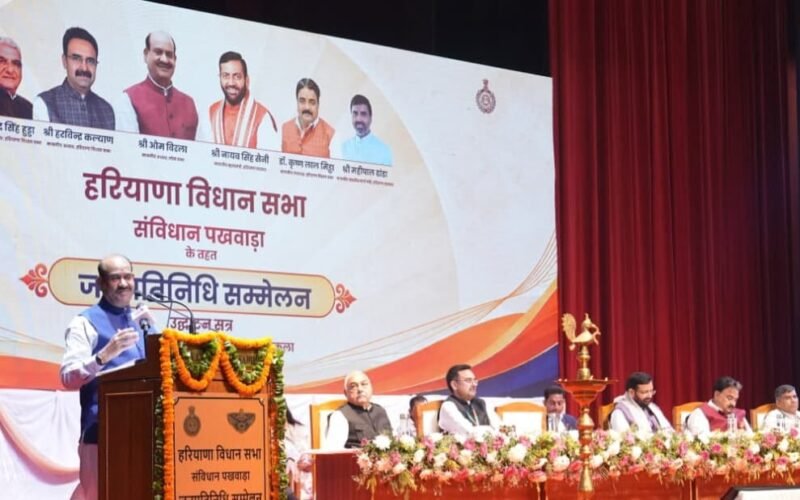
Chandigarh (Balwinder Singh): Lok Sabha Speaker Om Birla on Monday said that differences of opinion and dissent are essential parts of democracy and must be respected. He called on elected representatives across political parties to work together for the development of Haryana and the country, stressing that public service is a greater responsibility than merely running the government.
Birla was addressing the inaugural session of a conference of public representatives organised under the Haryana Assembly’s Constitution Fortnight at Indradhanush Auditorium in Panchkula.
Haryana Chief Minister Nayab Singh Saini, Assembly Speaker Harvinder Kalyan, Leader of Opposition Bhupinder Singh Hooda, Deputy Speaker Krishan Middha and Parliamentary Affairs Minister Mahipal Dhanda were among those present at the event.
‘Dissent Gives Direction And Inspires Action’: Om Birla
Birla said democracy allows different opinions and perspectives, with both agreement and disagreement playing an important role in public life.
“Dissent gives direction, offers a vision and inspires us to work,” he said, adding that differences should not prevent elected representatives from making collective efforts for the progress of the state and the country.
He said governing was a responsibility, but serving the people was an even greater obligation.
Om Birla Highlights Constitution’s Role In India’s Democracy
The Lok Sabha Speaker described the Constitution as the guiding force behind India’s democratic institutions and traditions. He said it was not merely a framework for running the government but reflected the country’s national consciousness, aspirations and expectations.
Recalling the contribution of the Constitution’s makers, Birla paid tribute to Dr BR Ambedkar, chairman of the Drafting Committee, members of the Constituent Assembly and prominent personalities from the Haryana-Punjab region who contributed to the constitutional process.
He noted that the Constitution was shaped through extensive discussions and differences of opinion in the Constituent Assembly.
Birla also recalled the challenges India faced after Independence, including the integration of princely states, establishing a political system and adopting parliamentary democracy despite the country’s linguistic, cultural, geographical and religious diversity.
He said the Constitution guaranteed fundamental rights, equality, fraternity and justice, while providing a framework for democratic participation at every level of governance.
Haryana’s 60-Year Journey And Contribution To Development
Birla said Haryana had remained among the country’s leading states in development despite facing several challenges during its 60-year journey.
He credited the state’s progress to the contributions of farmers, workers, young people, entrepreneurs and sportspersons. He also highlighted the role of Haryana’s personnel in protecting the country’s borders and maintaining internal security.
The Lok Sabha Speaker said the Haryana Assembly had contributed to the state’s development over the past six decades through the participation of its members, debates and discussions.
He also praised the Assembly for maintaining traditions of constructive debate, dialogue and reasoned discussion, saying these had strengthened the institution’s dignity.
Birla Calls For Stronger Democratic Institutions And Public Service
Emphasising the responsibilities of different constitutional institutions, Birla said legislatures were responsible for framing laws and policies while reflecting people’s aspirations. The executive was responsible for implementing laws impartially, while the judiciary had the duty of ensuring accessible justice.
He said elected representatives must uphold democratic traditions and work collectively, irrespective of differences in their political views.
Birla also acknowledged the contributions of current and former public representatives, saying that their responsibility towards society continued even after they left elected office.
He urged them to remain committed to improving the lives of people at the grassroots level, particularly those at the bottom of the social and economic ladder.
Bringing meaningful change to the lives and socio-economic conditions of the last person in society was a moral responsibility of every public representative, he said.
