

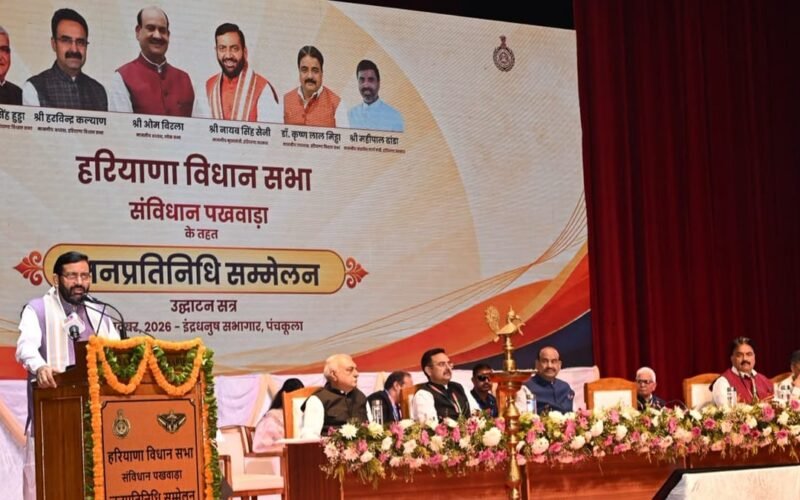
Chandigarh (Balwinder Singh): Haryana Chief Minister Nayab Singh Saini on Monday said that political parties and elected representatives may have different ideologies, but the state’s progress and the well-being of its people should remain their common objective.
Addressing the inaugural session of a conference of public representatives organised under the Haryana Assembly’s Constitution Fortnight at Indradhanush Auditorium in Panchkula, Saini said all elected representatives shared the responsibility of understanding public needs and contributing to the state’s development.
He said their identity was rooted in representing the people of Haryana, irrespective of their political affiliations.
The Chief Minister also called on legislators to uphold the dignity of the Assembly, strengthen public dialogue and reflect constitutional values through their conduct.
Saini Reflects On Haryana’s 60-Year Journey
Congratulating the people of Haryana on the state’s 60th anniversary, Saini said the conference offered an opportunity to draw inspiration from the state’s past while shaping its future.
He welcomed Lok Sabha Speaker Om Birla’s presence at the event, saying his guidance on parliamentary procedures, the dignity of the House and the responsibilities of elected representatives would be valuable.
Saini also recalled President Droupadi Murmu’s participation in the state’s Diamond Jubilee celebrations.
Describing Haryana’s six-decade journey, he said its development was not limited to the expansion of roads, institutions and industries. The contribution of farmers, workers, women, young people and ordinary citizens had also shaped the state’s progress.
He highlighted Haryana’s journey from agricultural fields and rural pathways to industrial centres and expressways, as well as its achievements in sports. He said discussions, decisions and legislation in the Assembly had also played an important role in shaping the state.
CM Calls For Greater Representation In Haryana Assembly
Saini recalled that Haryana was formed on November 1, 1966, with 54 members in its Legislative Assembly. The number of seats increased to 81 in 1967 and later to 90 in 1977.
He said there was a need to increase the number of Assembly seats to enable greater public representation and make facilities more accessible to people.
Haryana is currently in its 15th Assembly. Saini also noted that the first sitting of the state Assembly was held on December 6, 1966, when the government faced major challenges in expanding basic facilities such as education, healthcare, drinking water, irrigation, electricity, roads and administration.
He expressed gratitude to the legislators who contributed to laying the foundation for the state’s development under those circumstances.
Saini Stresses Accountability And Dignity In Assembly Debates
The Chief Minister said constitutional principles such as justice, liberty, equality and fraternity must be reflected in the decisions and conduct of public representatives.
He described the Assembly as a key institution responsible for making laws, approving the use of public funds and ensuring government accountability.
Saini said parliamentary procedures such as Question Hour, calling attention motions, budget discussions and committee work could help address public grievances and improve citizens’ lives. He stressed the need for legislators to remain prepared, study issues and maintain regular contact with people in their constituencies.
He said the government must take issues raised by the Opposition in the public interest seriously. At the same time, constructive criticism and practical suggestions were important contributions to public life.
While sharp debates were part of democracy, he said, legislators must maintain the dignity of their language and challenge opposing views through arguments rather than personal attacks.
CM Urges Legislators To Take Constitutional Awareness Beyond Assembly
Saini said citizens, particularly young people, closely observe the words and conduct of elected representatives through digital platforms. He stressed the importance of verifying facts, avoiding personal allegations and using responsible language while discussing constitutional institutions.
He added that an elected representative’s responsibility extended to the entire constituency after elections, not just their political supporters.
The Chief Minister called for taking discussions on the Constitution beyond official events and into villages, schools and neighbourhoods. He suggested that current and former legislators organise constitutional awareness programmes for young people, including youth parliaments, readings of the Preamble and discussions on local issues.
He said citizens should be made aware of both their rights and fundamental duties, including protecting public property, respecting women, conserving the environment and promoting social harmony.
Public Participation Key To Developed Haryana Vision
Saini said public participation was essential to building a developed Haryana, adding that residents were best placed to understand the needs of their respective areas.
He urged elected representatives to ensure that the views of women, farmers, workers, young people, entrepreneurs and disadvantaged communities were considered while deciding development priorities.
Referring to the vision of a developed India by 2047, he said Haryana needed to focus on quality education, skills, employment, modern agriculture and better healthcare. Water conservation, environmental protection and balanced urban development would also require sustained attention.
He said technological opportunities and the benefits of development should reach all sections of society, in both rural and urban areas.
Concluding his address, Saini urged all public representatives to commit themselves to strengthening the dignity of the Assembly, improving public dialogue and upholding constitutional values through their conduct. He said the legacy of the present generation would be reflected in the opportunities, dignity and public trust passed on to future generations.
