

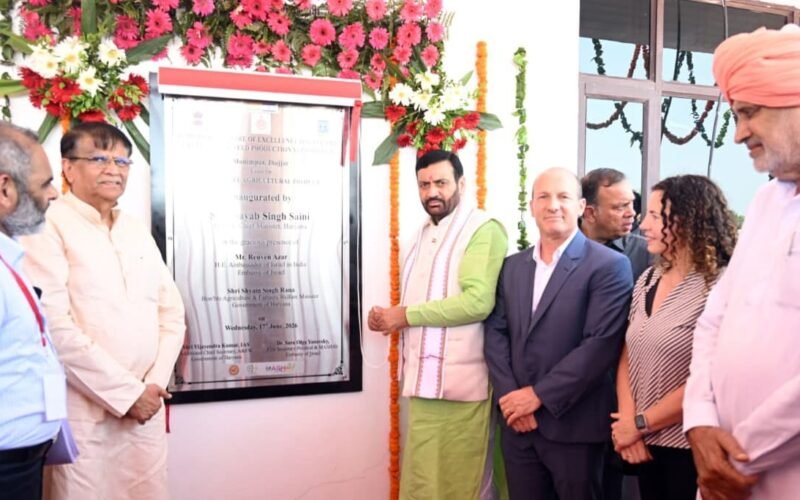
Chandigarh (Balwinder Singh): Haryana Chief Minister Nayab Singh Saini on Wednesday launched a series of development projects worth over ₹75 crore in Jhajjar district, including a state-of-the-art horticulture research centre at Raiya and a Seed Production Technology Centre of Excellence at Munimpur, aimed at strengthening crop diversification and boosting farmers’ incomes across the state.
The two flagship projects, developed at a combined cost of more than ₹21 crore, are expected to accelerate innovation in horticulture, improve access to quality planting material and introduce advanced farming techniques to growers.
Speaking at the inauguration ceremony, the Chief Minister said Haryana is steadily emerging as one of India’s leading horticulture-producing states and that modern research, technology and international collaboration will play a key role in the sector’s future growth.
“The newly established research and excellence centres will act as hubs for innovation, farmer training and technology transfer. These institutions will help farmers adopt modern practices, improve productivity and increase profitability,” Saini said.
Apart from the horticulture projects, the Chief Minister also dedicated seven additional development works worth ₹53.60 crore to the public. These include new government school buildings, a mini secretariat and residential complex in Jhajjar, and drinking water infrastructure projects for Saundhi and Nimana villages.
Raiya Research Centre to Drive Innovation in Horticulture
Built across nearly 100 acres at a cost of ₹13.27 crore, the Raiya Horticulture Research Centre will focus on developing improved and climate-resilient varieties of fruits, vegetables and flowers. Research activities will also cover water conservation, pest and disease management, quality enhancement and production efficiency.
According to the Chief Minister, the centre will serve as a bridge between scientists and farmers, ensuring that research outcomes directly benefit agricultural communities.
He added that Haryana has already established horticulture research centres in Jind, Ambala, Sonipat and Karnal, while another centre is under construction in Charkhi Dadri.
Modern Technology and Global Collaboration
Highlighting international cooperation in agriculture, Saini said the Seed Production Technology Centre of Excellence at Munimpur would promote innovation through advanced technologies and global partnerships. The project is expected to provide farmers with improved production techniques and better market access.
The event was attended by Israel’s Ambassador to India, Reuven Azar, who praised the growing collaboration between India and Israel in agriculture and horticulture.
Azar said Israeli expertise in water management, precision farming and agricultural innovation has already contributed significantly to Haryana’s horticulture sector through multiple Centres of Excellence established across the state.
He expressed confidence that the newly inaugurated facilities would further strengthen farmer access to advanced technologies and modern cultivation practices.
Haryana Expanding Horticulture Footprint
The Chief Minister noted that the state government has been actively promoting crop diversification through initiatives such as the ‘Mera Pani Meri Virasat’ programme, Bhavantar Bharpai Yojana, micro-irrigation schemes and farmer producer organisations.
He informed that financial assistance amounting to ₹196 crore has been provided to nearly 39,557 farmers under the Bhavantar Bharpai Scheme. Additionally, subsidies ranging from 50 to 85 per cent are being offered for vegetable cultivation, mushroom farming and protected agriculture.
Saini said Haryana currently has 14 Israel-supported Centres of Excellence that are helping farmers achieve higher productivity in fruits, vegetables, floriculture and beekeeping.
₹2,738-Crore Sustainable Horticulture Project Announced
The Chief Minister also highlighted the state’s ambitious ₹2,738-crore Sustainable Horticulture Promotion Project, designed to reduce post-harvest losses and improve farmers’ access to markets.
Under the initiative, the government plans to establish 400 horticulture clusters and organise 500 producer groups. The project will also focus on modern irrigation systems, rainwater harvesting structures, protected cultivation and advanced technologies such as hydroponics, aeroponics, greenhouse farming and vertical agriculture.
The government is also working on a new cold-chain policy aimed at improving storage facilities, stabilising prices and boosting agricultural exports.
Youth Encouraged to Become Agri-Entrepreneurs
Calling on young people to explore opportunities in agriculture beyond traditional farming, Saini said modern agriculture has evolved into a technology-driven sector offering vast entrepreneurial potential.
He highlighted emerging opportunities in agri-startups, food processing, digital marketing, artificial intelligence, drone technology and export-oriented businesses.
“Agriculture should not be viewed merely as a source of employment. It should be seen as a platform for entrepreneurship and job creation,” he said.
Agriculture and Farmers’ Welfare Minister Shyam Singh Rana echoed similar sentiments, stating that agriculture now encompasses multiple specialised sectors, including horticulture, floriculture, seed production, fisheries, livestock and food processing.
Major Development Announcements for Badli Constituency
During the event, the Chief Minister also announced a series of infrastructure projects for the Badli Assembly constituency. These include a 50-bed hospital, a model sports stadium, road strengthening works, crop procurement centres, drainage improvements, sewerage networks and drinking water projects.
Additional funding was also announced for rural development works aimed at improving civic infrastructure and public services across the constituency.
The Chief Minister reiterated that the state government remains committed to balanced regional development and will continue prioritising projects that improve farmers’ livelihoods, strengthen rural infrastructure and create new economic opportunities.
