

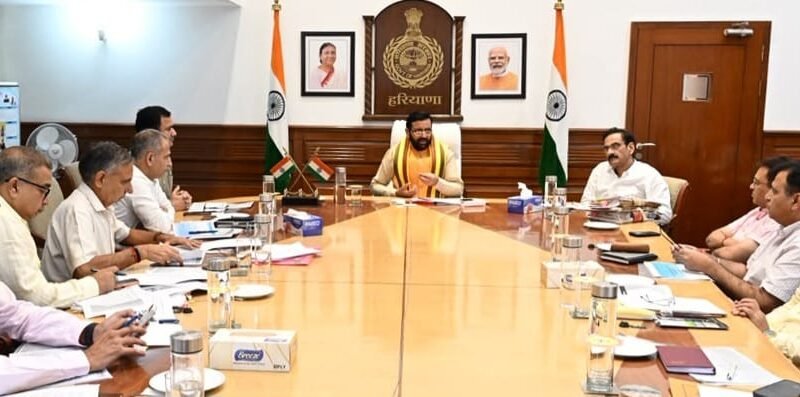
Chandigarh (Balwinder Singh): Haryana Chief Minister Nayab Singh Saini has directed officials to draft comprehensive proposals covering over 200,000 acres of land under the Watershed Development Component of the Pradhan Mantri Krishi Sinchayee Yojana 2.0, urging the inclusion of more administrative blocks to maximise regional coverage. Chairing a high-level review meeting in Chandigarh on Thursday alongside Chief Principal Secretary Rajesh Khullar and senior administrative secretaries, the Chief Minister instructed the agriculture and irrigation departments to intensify ground-level water recharge interventions while expanding dependable irrigation facilities across arid and semi-arid tracts of the state.
During the review, Chief Minister Saini called for focused awareness drives to encourage sugarcane growers across the state to adopt drip irrigation systems, noting that micro-irrigation remains critical for reducing heavy groundwater extraction. He also instructed authorities to identify prospective locations in the Morni and Shivalik foothill belts to construct check dams and dedicated water retention structures. These conservation projects are intended to capture seasonal rainwater runoff efficiently, thereby supplying steady raw water for rural drinking schemes while reviving natural aquifers in vulnerable foothill belts.
The Chief Minister conducted an exhaustive assessment of several flagship water security programs, including the Accelerated Irrigation Benefit Programme, Har Khet Ko Pani, Per Drop More Crop, the Intensive Watershed Development Management Programme, and the Atal Bhujal Yojana. Providing progress figures, Saini revealed that the government has already expended approximately ₹40 crore on micro-watershed projects spread across 74 villages in nine blocks spanning the districts of Bhiwani, Charkhi Dadri, Mahendragarh, Gurugram, and Yamunanagar. These projects included blocks such as Behal, Loharu, Badhra, Nangal Choudhary, Mahendragarh, Sohna, Pataudi, Chhachhrauli, and Sadhaura.
Under these initiatives, the administration completed 531 distinct conservation projects spanning 16 specific intervention categories, encompassing rainwater harvesting tanks, percolation ponds, recharge borewells, soakage pits, pond de-silting, rooftop harvesting mechanisms, and underground pipelines. Bhiwani recorded 229 such interventions, followed by 107 in Gurugram, 82 in Charkhi Dadri, 77 in Mahendragarh, and 36 in Yamunanagar. Additionally, 70 reservoirs spanning nearly 422 acres have been developed, with another 131 reservoirs planned under the Water Secure Haryana initiative, successfully extending recharge and irrigation benefits across 77,500 acres of agricultural land. Under the Atal Bhujal Yojana, 40,405 farmers have adopted drip irrigation across 77,175 hectares, backed by extensive borewell installations across northern districts.
