

Chandigarh (Balwinder Singh): The Haryana government has formulated a multi-pronged action plan aimed at the rejuvenation and pollution control of the Yamuna River. Under this initiative, the state will develop an additional treatment capacity of 580 million litres per day (MLD) to handle sewage and industrial effluent. Alongside wastewater management, the plan includes the setup of nine biogas plants designed for the scientific disposal of 1,455 tonnes of organic waste daily. These combined environmental infrastructure projects are specifically designed to reduce the volume of pollutants discharged into the Yamuna, upgrade water quality, and strengthen the river’s surrounding ecosystem.
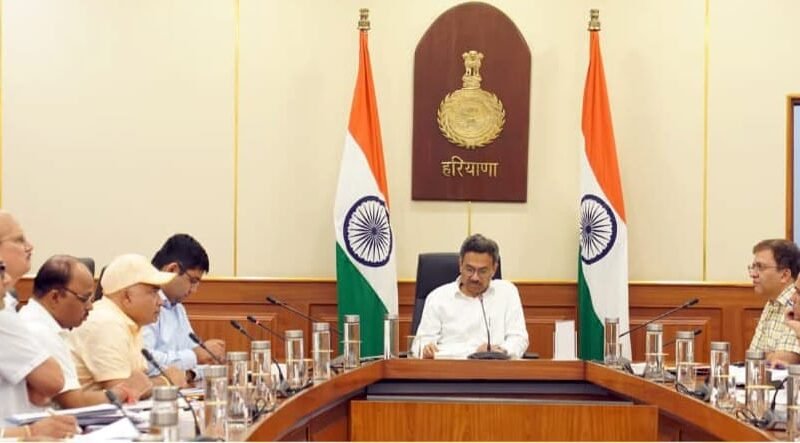
Chief Secretary Anurag Rastogi led a high-level review meeting in Chandigarh to evaluate the progress of these ongoing anti-pollution initiatives. He instructed all implementing agencies to accelerate active projects, swiftly clear any lingering bureaucratic or structural bottlenecks, and strictly adhere to established timelines. Highlighting the infrastructure expansion, Haryana State Pollution Control Board Chairman Vinay Pratap Singh noted that ten new sewage treatment plants (STPs) with a combined capacity of 423.5 MLD are being established at an estimated cost of 828.88 crore rupees. To manage industrial waste, nine Common Effluent Treatment Plants (CETPs) with a capacity of 156.5 MLD are planned, while the construction of two other CETPs with a 30 MLD capacity is already underway.
Several facilities are nearing completion, including a 3 MLD STP in Matlauda, Panipat, which has reached 95 per cent completion and is scheduled for a July 31, 2026 deadline. Another 2 MLD STP in Bajghera, Gurugram, is currently 85 per cent complete and is expected to be fully operational by August 31, 2026. The Chief Secretary also reviewed the rollout of the remaining 423.5 MLD STPs, which are slated for deployment across strategic regional hubs including Dhanwapur, Behrampur, Naurangpur, and Sector-107 in Gurugram, Mirzapur and Surajkund in Faridabad, Kundli, Sonipat, and Samalkha in Panipat. Officials confirmed that tenders have been floated and deadlines locked for multiple sites, while the rest are moving through final approval stages.
The state is simultaneously addressing commercial discharge through the setup of nine CETPs located in high-output zones such as Pratapgarh and Mirzapur in Faridabad, Badshahpur and Sectors 18, 34, and 37 in Gurugram, and Sector-29 and industrial areas in Panipat and Kundli. Concurrently, the nine biogas plants will be distributed across Sonipat, Faridabad, Gurugram, Karnal, Rohtak, and Yamunanagar to handle 1,455 tonnes of waste per day. Joint execution by the Panchayati Raj Department, HAREDA, GAIL, and BPCL will drive the waste-to-energy initiative, ensuring scientific waste disposal while generating clean power. Chief Secretary Rastogi reiterated that restoring the Yamuna remains a top priority, emphasizing that seamless inter-departmental coordination will fortify Haryana’s environmental framework and secure a cleaner river ecosystem.
