

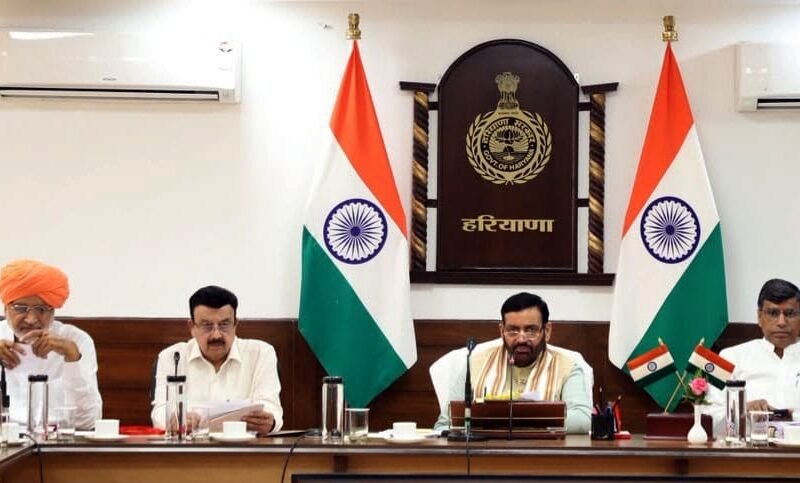
Chandigarh (Balwinder Singh): Haryana Chief Minister Nayab Singh Saini chaired a meeting of the High Powered Purchase Committee (HPPC) on Tuesday, where approval was granted for the establishment of 52 modern static agriculture laboratories and 32 development projects worth approximately ₹1,468.25 crore across the state.
The Chief Minister said that the agriculture laboratories, to be set up at a cost of ₹28 lakh, will help farmers test nitrogen and urea levels in their agricultural land. The initiative aims to provide scientific guidance on fertilizer usage and help improve soil fertility.
According to the Chief Minister, around 12 lakh farmers will benefit annually through soil testing services provided by these laboratories. He also announced that a large-scale awareness campaign will be launched to encourage farmers to adopt natural farming practices. A detailed roadmap will be prepared for the campaign, with ministers and MLAs assigned responsibilities in their respective districts. Saini said he would personally participate in the awareness drive. Special focus will be placed on promoting natural farming across 4,000 acres in the Morni region.
The committee also approved the implementation of a Revenue Court Case Management System at an estimated cost of ₹9 crore. The digital system will facilitate transparent and efficient resolution of revenue-related court cases, including land partition disputes and other legal matters.
Several projects related to irrigation, public health engineering, power infrastructure, urban development and public works also received approval. These include strengthening works at Kaushalya Dam, reconstruction of the Bhaloth Sub-Branch, construction of a pumping station to supply raw water to Hisar Airport, development of the Rana Distributary, drainage projects in Panchkula and the construction of sewage treatment facilities.
The committee approved the construction of a Guru Ravidas Bhawan and Museum in Sector 33, Kurukshetra, at a cost of ₹76.60 crore. The project is expected to be completed within 24 months. The Chief Minister said the facility would serve as an important centre of faith and cultural heritage, adding that quality standards would be strictly maintained during construction.
To strengthen skill development and industrial training, approvals were also granted for the procurement of machinery and equipment for training institutions, along with cement purchases and other infrastructure-related requirements for various boards and corporations.
The Gurugram Metropolitan Development Authority (GMDA) received approval for road repair works from Basai Chowk to Old Railway Road and from Railway Road to IFFCO Chowk. Additionally, a 132 KV power house at the International Fruit and Vegetable Market in Ganaur and ten new 33 KV substations along with 11 KV line works in various locations were approved.
The committee also cleared the expansion of the 9 MLD Common Effluent Treatment Plant (CETP) at Kundli, construction of CC roads in IMT Phase-III Bawal and the development of an Ayush Hospital at Shri Krishna Ayush University. These projects are expected to involve an investment of approximately ₹465 crore. Approval was also granted for the construction of 56 residential units for officers in Jind and white-topping work on the Rewari-Narnaul National Highway-11.
Under the AMRUT 2.0 scheme, projects approved for Sirsa include the construction of an additional boosting station, pipeline network, a 4.50 MLD water treatment plant and a 10 MLD sewage treatment plant. These projects are estimated to cost around ₹41 crore. Additional water storage and boosting infrastructure will also be developed to strengthen drinking water supply in the city.
In Ambala, a 60 MLD sewage treatment plant will be constructed in Devi Nagar at a cost of ₹104 crore. The committee also approved drainage projects in waterlogging-prone areas. In Rewari, a 24 MLD primary treatment plant will be upgraded, while new water infrastructure projects will improve drinking water supply to 17 villages in the Bishanpur area.
The meeting was attended by Industries and Commerce Minister Rao Narbir Singh, School Education Minister Mahipal Dhanda, Agriculture and Farmers Welfare Minister Shyam Singh Rana, Public Health Engineering Minister Ranbir Gangwa, Irrigation Minister Shruti Choudhry and several senior government officials.
