

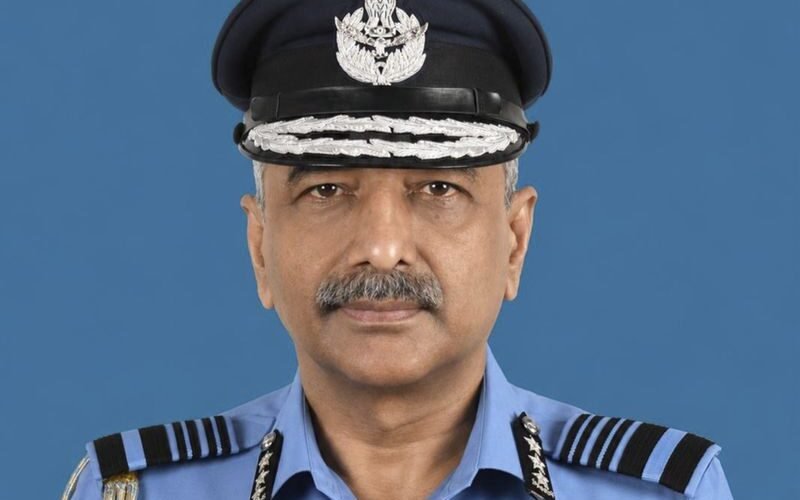
New Delhi (Gurpreet Singh): Air Marshal Ashutosh Dixit is set to take charge as the 29th Chief of the Air Staff on October 31, becoming the only officer from his commissioning batch to occupy a place in the Indian Air Force’s (IAF) top hierarchy.
Currently serving as Vice-Chief of the Air Staff, Dixit was commissioned into the IAF’s fighter stream on December 6, 1986. He will succeed Air Chief Marshal Amar Preet Singh, who retires on October 31.
The leadership transition also brings changes to the IAF’s senior command structure. Air Marshal Inderpal Singh Walia, currently heading the Eastern Air Command, has been appointed as the next Vice-Chief of the Air Staff and will assume charge on November 1.
Who Are the Senior-Most Officers After Ashutosh Dixit?
The next two senior-most officers in the IAF hierarchy are Air Marshal Seethepalli Shrinivas, Air Officer Commanding-in-Chief (AOC-in-C) of Training Command, and Air Marshal Tejinder Singh, Chief of Integrated Defence Staff.
Both officers were commissioned into the IAF in June 1987, making them members of the batch immediately junior to Dixit’s.
Air Marshal Inderpal Singh Walia, who was commissioned into the fighter stream on June 11, 1988, will replace Dixit as Vice-Chief. Walia is currently the Air Officer Commanding-in-Chief of Eastern Air Command.
The Ministry of Defence announced his appointment on October 30, with effect from November 1.
How Does Seniority Influence the Appointment of an Air Chief?
The appointment of a service chief is guided by seniority and merit, with the government generally following the convention of selecting the senior-most eligible commander.
In the IAF, seniority is not determined by commissioning date alone. Personal service numbers, which reflect an officer’s position in the order of merit at the time of commissioning, can also become relevant when officers are close in seniority.
The principle of seniority-cum-merit has generally guided the selection of the Air Chief, although the government has made exceptions in the past.
The importance of service numbers was also visible in the Army’s leadership transition earlier this year. When General Dhiraj Seth was appointed Chief of the Army Staff, he was senior to his coursemate Lieutenant General Manjinder Singh by 21 positions in their personal service numbers.
Both officers were commissioned in December 1986. General Seth had also taken over as General Officer Commanding-in-Chief of the South Western Command in November 2023, a month before Lieutenant General Manjinder Singh assumed charge of the Army Training Command.
Why Fighter Pilots Dominate the IAF’s Top Leadership
The composition of the IAF’s senior leadership also highlights the continued dominance of fighter pilots in its command structure.
The Air Force has 10 officers at the AOC-in-C level, including the incoming Air Chief. The Vice-Chiefs of the three services and the heads of their respective commands hold equivalent status.
Among the senior IAF officers, Air Marshal Yalla Umesh, a technical officer, heads the Maintenance Command, while Air Marshal Sandeep Thareja, a medical officer, serves as Director General of Armed Forces Medical Services.
The other AOC-in-Cs in the flying branch belong to the fighter stream. There is currently no officer from the transport or helicopter stream in the IAF’s top operational hierarchy.
The historical pattern is even more pronounced at the level of the Chief of the Air Staff. Of the 29 officers who have headed the IAF since Independence, including three British officers who served until March 1954, all but one have come from the fighter stream.
The exception was Air Chief Marshal Fali Homi Major, a helicopter pilot who served as Air Chief from March 2007 to May 2009.
When Were Seniority Norms Deviated From in Military Appointments?
Although seniority has generally been followed in appointments to the top military posts, there have been instances of officers being superseded.
Historical accounts cite the cases of Air Marshal MM Engineer, who was reportedly passed over in favour of Air Marshal OP Mehra for the Air Chief’s post in 1973, and Air Marshal MM Singh, who was superseded by Air Marshal SK Mehra in 1988.
Another prominent instance came in 2016, when General Bipin Rawat was appointed Army Chief, superseding two other Army Commanders. He later became India’s first Chief of Defence Staff.
Dixit’s elevation, meanwhile, follows the conventional seniority-led route and marks the beginning of a new leadership phase for the Indian Air Force.
