

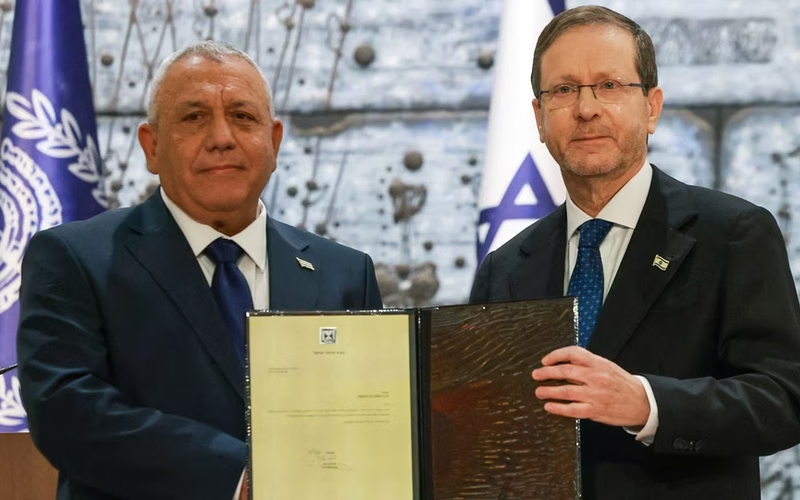
Jerusalem (Rajeev Sharma): Israeli President Isaac Herzog on Sunday formally tasked Yashar Party leader Gadi Eisenkot with forming the country’s next government after he received recommendations from 67 lawmakers, compared with 46 who backed Prime Minister Benjamin Netanyahu.
The decision gives Eisenkot the first opportunity to assemble a coalition following the October 27 general election, which left no political bloc with the 61 seats required for a majority in the 120-member Knesset, Israel’s parliament.
Eisenkot has 28 days to form a government. Herzog can grant him an extension of up to 14 additional days if required. The mandate, however, does not guarantee that he will be able to secure enough support to take office.
Israel Government Formation: Why Eisenkot Got The Mandate
During consultations with political parties, factions representing 67 lawmakers recommended Eisenkot for the premiership. Netanyahu, who leads the Likud party, received recommendations from factions representing 46 lawmakers, while a seven-member faction did not endorse either candidate.
Although Netanyahu’s bloc remained the largest after the election, it failed to secure a parliamentary majority. His coalition lost its majority in the October 27 vote, creating an opening for the opposition to attempt to form an alternative government.
Eisenkot, a former military chief, leads the Yashar Party. His appointment follows consultations in which Herzog also held discussions with Netanyahu and other political leaders before making his decision.
Can Gadi Eisenkot Form A Coalition Without Arab Parties?
Eisenkot faces a difficult task despite receiving the backing of 67 lawmakers during the presidential consultations. His four-party opposition alliance secured 48 seats in the election, while Netanyahu’s bloc won 53. Arab-led parties secured a combined 19 seats, giving Eisenkot additional parliamentary support during the consultations.
However, Eisenkot has ruled out forming a coalition with Arab-led parties, creating uncertainty over how he will reach the 61-seat threshold. One possible route involves securing the support of ultra-Orthodox parties, while another could involve a minority government relying on outside support for key parliamentary votes.
A broader unity arrangement involving Likud has also been discussed. Eisenkot has indicated that he is open to including Netanyahu and one of his far-right allies in a unity government, provided he leads it.
He has described his objective as establishing a national emergency government and said that Israel cannot afford prolonged political deadlock or repeated elections.
Netanyahu Calls For Unity Government
Netanyahu has called for a national unity government as he seeks to remain in power despite his coalition losing its parliamentary majority.
In a video message issued shortly before Herzog’s announcement, the prime minister warned against forming a government with what he described as supporters of terrorism, referring to Arab-led parties. He has also alleged that these parties stole the election, a claim that remains unsubstantiated.
The political divide has complicated efforts to build a coalition. While Arab-led parties recommended Eisenkot during the presidential consultations, his position on excluding them from a government could make negotiations more difficult.
Eisenkot is expected to hold discussions with potential coalition partners, including Yisrael Beytenu leader Avigdor Liberman, whose party won seven seats. Israeli media reports said the two leaders were expected to meet on Monday.
What Happens If Eisenkot Fails To Form Government?
If Eisenkot fails to form a government within the allotted period, Herzog may give another lawmaker an opportunity to build a coalition. If subsequent attempts also fail, the process could eventually lead to the dissolution of the Knesset and fresh elections.
Israel has experienced repeated political deadlocks in recent years, going to the polls five times between 2019 and 2022.
Meanwhile, four opposition parties have called for the Knesset to elect a new speaker during its first sitting on November 10. Such a move could threaten the position of incumbent speaker Amir Ohana of Likud.
Ohana has said he would not allow a vote on the matter during the parliament’s first session, but would schedule a debate on choosing his successor within the following week if a majority of lawmakers formally requested one.
The immediate challenge for Eisenkot is to turn the recommendations he received into a workable parliamentary coalition. Until a new government secures the Knesset’s confidence, Netanyahu’s outgoing government remains in office in a caretaker capacity.
