

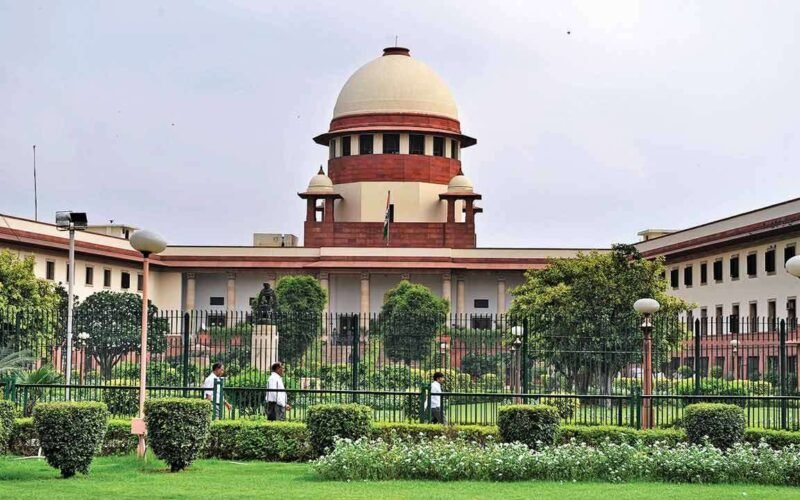
New Delhi (Gurpreet Singh): The Supreme Court on Monday expressed sharp dissatisfaction with the Union government’s decision to restrict trade margin capping exclusively to anti-cancer drugs, remarking that there was “hardly anything to be happy about” and questioning why similar caps have not been extended across other vital pharmaceutical categories.
The Centre submitted before the top court that it has resolved to cap trade margins on anti-cancer drugs at 30 percent of the Maximum Retail Price (MRP), a step considered during the 151st meeting of the National Pharmaceutical Pricing Authority (NPPA) on October 8. According to the government, invoking extraordinary powers under Paragraph 19 of the Drugs (Prices Control) Order (DPCO), 2013, was projected to yield annual savings of approximately ₹2,500 crore for patients without disrupting market availability.
A bench comprising Justice Vikram Nath and Justice Sandeep Mehta termed the measure inadequate in addressing systemic profiteering across the healthcare sector. The judges pointed to glaring disparities in medical retail pricing, highlighting instances where an intravenous saline bottle costing ₹11 is billed at ₹270, an Indian-manufactured cardiac stent costing ₹5,000 is sold to patients for upwards of ₹25,000, and common antibiotics like Azithromycin costing ₹28 are retailed above ₹70.
Countering arguments by Solicitor General Tushar Mehta—who submitted that wider price ceilings could discourage distribution networks and curtail the availability of medicines in remote regions—the bench held that ensuring the distribution of DPCO-regulated medicines is the fundamental obligation of the state. The court underscored that the core issue lies in expanding the schedule of essential drugs to protect patients from excessive retail markups.
Granting the Union government additional time to formulate regulatory modalities for capping price margins across wider categories of essential medicines, the Supreme Court listed the matter for further hearing on October 27.
