

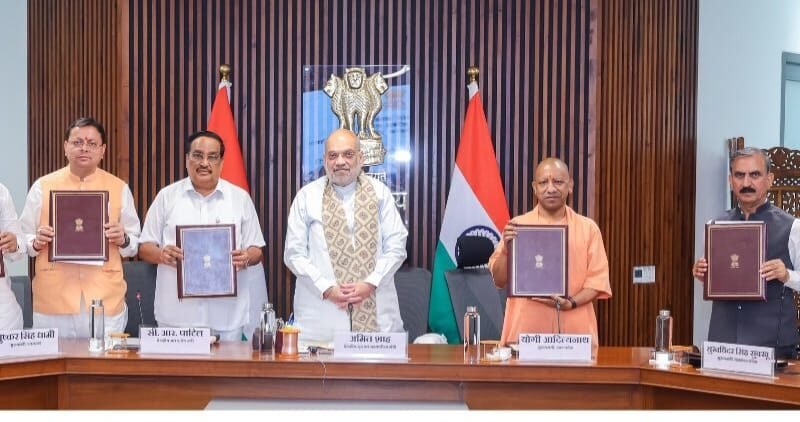
Chandigarh (Balwinder Singh): In a major breakthrough resolving decades-old inter-state water sharing disputes, the Chief Ministers of six northern states signed a historic agreement for the Kishau Multipurpose Project on Tuesday. The pact was inked in the presence of Union Home and Cooperation Minister Amit Shah and Union Jal Shakti Minister C.R. Patil. The signing ceremony brought together Uttar Pradesh Chief Minister Yogi Adityanath, Haryana Chief Minister Nayab Singh Saini, Uttarakhand Chief Minister Pushkar Singh Dhami, Himachal Pradesh Chief Minister Sukhvinder Singh Sukhu, Rajasthan Chief Minister Bhajan Lal Sharma, and Delhi Chief Minister Rekha Gupta, alongside Union Home Secretary and central and state water resources secretaries.
Addressing the gathering, Amit Shah termed the event a historic milestone and the tenth major inter-state river dispute settled under Prime Minister Narendra Modi’s tenure. Shah noted that regional water issues, including the Lakhwar and Shahpurkandi projects in 2018, Renukaji in 2019, Ken-Betwa in 2021, and recent accords in the Narmada and Son basins, have seen systematic resolution through the Jal Shakti Ministry and Zonal Councils. He commended C.R. Patil and the six state leaderships for transcending regional divides to finalize the Kishau framework, which had been pending since an overarching basin agreement was first mooted in May 1994.
Declared a National Project, the initiative will receive 90 per cent of its capital funding from the central government, with the remaining 10 per cent shared among the beneficiary states. The project entails constructing a 232.6-metre-high concrete gravity dam on the Tons River along the border of Uttarakhand and Himachal Pradesh, creating a live storage capacity of 1,562 million cubic metres. The storage will irrigate roughly 97,000 hectares of farmland and generate approximately 1,476 million units of clean hydroelectricity annually.
Shah pointed out that the agreement corrects a historical policy failure regarding the ecological flow of the Yamuna River, where water was apportioned without leaving sufficient volumes for the river channel itself. With 25 per cent of the newly stored discharge directed downstream, the project will significantly bolster Delhi’s municipal supply while helping rejuvenate the Yamuna and Ganga river ecosystems.
