

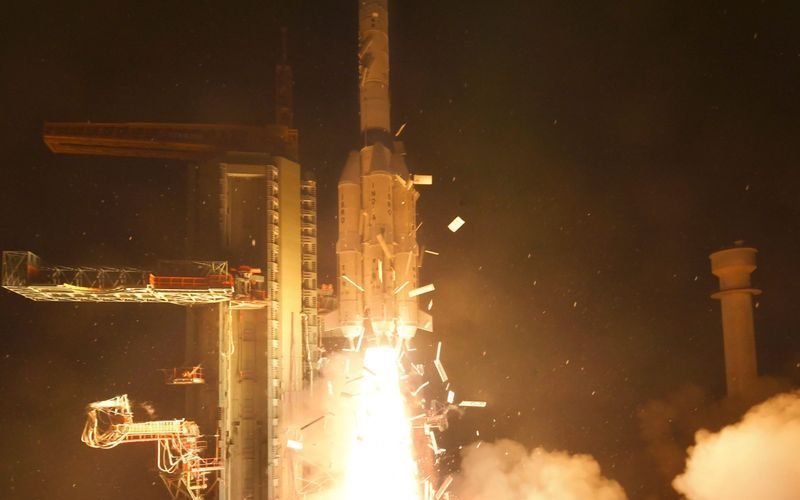
New Delhi (Gurpreet Singh): The Indian Space Research Organisation (ISRO) successfully conducted the third and final orbit-raising manoeuvre of the EOS-05 spacecraft on Monday evening, securing the advanced satellite into its intended geosynchronous orbit. Launched during the early hours of September 4 aboard the GSLV-F17 rocket from Sriharikota, the spacecraft has completed its orbital adjustments and remains in optimal health, according to space agency officials.
The final orbital operation commenced to raise the perigee of the satellite, concluding at 8:57 PM on September 7 after the onboard Liquid Apogee Motor (LAM) fired continuously for 1,247 seconds. The successful burn established an estimated orbit measuring 34,903 kilometres by 35,884 kilometres. Marked as the 19th flight of the Geosynchronous Satellite Launch Vehicle (GSLV), the rocket had initially injected the payload into a Sub-Geosynchronous Transfer Orbit roughly 4,000 kilometres above Earth, requiring sequential propulsion maneuvers to elevate it into a permanent geosynchronous position.
Representing a key technological leap in national space infrastructure, EOS-05 stands as India’s first-ever earth observation satellite positioned in a high-altitude geosynchronous platform. The state-of-the-art spacecraft provides real-time optical surveillance capabilities across the subcontinent, designed to cater to comprehensive civilian Earth-imaging operations alongside strategic national security requirements.
