

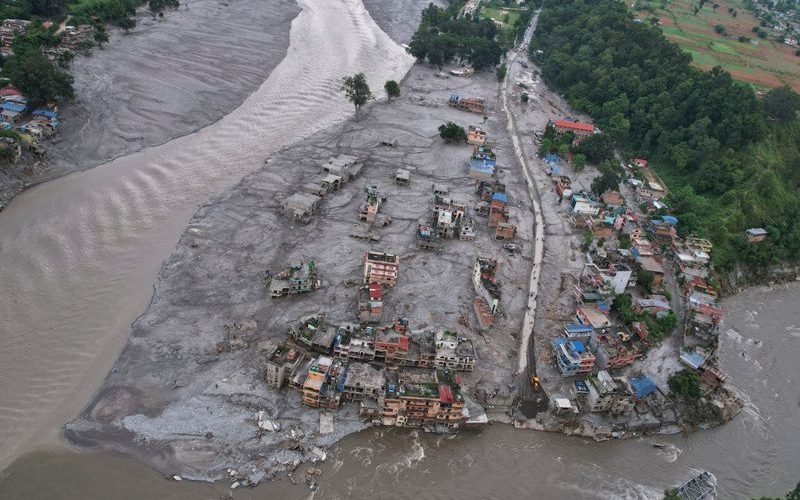
Kathmandu (Gurpreet Singh)— The death toll from devastating flash floods in central Nepal reached 669 on Saturday as emergency crews continued recovering bodies amid renewed rainfall, swelling river levels, and the persistent threat of secondary flooding across the Bhotekoshi River basin. Nearly 2,400 people remain unaccounted for, including at least 320 foreign nationals, while more than 4,400 individuals have been rescued or evacuated as rescue teams struggle against time and rugged terrain to access cut-off mountain settlements.
The catastrophe, triggered on Wednesday by a massive glacial rock-and-ice avalanche near the Nepal-Tibet border, sent a devastating wall of water, mud, and boulders coursing down the Bhotekoshi and Trishuli river systems. The torrent destroyed bridges, severed highway networks, submerged towns like Timure, and damaged multiple downstream hydroelectric installations. Across the border in the Tibet region, Chinese authorities have reported seven fatalities and more than 550 people missing.
Rescue operations have deployed more than 15,000 security personnel and ongoing helicopter sorties to evacuate stranded residents and airlift vital supplies into isolated areas. Authorities confirmed that among the rescued are at least 261 foreign tourists previously reported missing, including 167 Indian citizens alongside nationals from China, Ukraine, Germany, Malta, the United States, and several European and Middle Eastern countries.
An 11-member specialized Indian rescue team conducted site reconnaissance on Saturday across damaged hydropower structures, deploying to Trishuli in Nuwakot district to assist in complex operations to reach workers trapped inside flooded tunnels. While Nepali forces have rescued 191 workers and residents from power installations so far, many remain trapped. India has dispatched 57.6 tonnes of relief consignments to affected zones, prompting Nepal’s Finance Minister Swarnim Wagle to publicly thank the Indian government for its swift and generous humanitarian assistance.
Ongoing weather conditions continue to imperil relief operations, with the national meteorology department issuing fresh warnings for rain and thunderstorms across the central river corridors. Although the vital Mugling-Kathmandu highway briefly reopened on Saturday after days of closure, authorities remain on high alert as upstream water levels and fragile terrain continue to pose severe landslide and surge hazards.
