

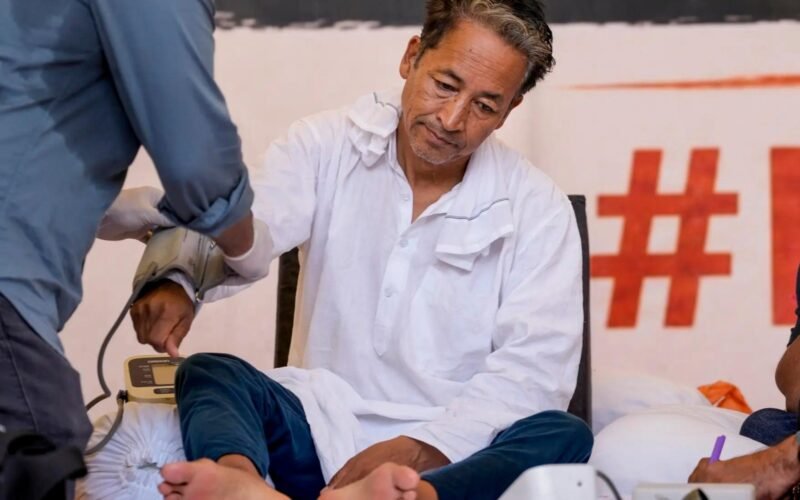
New Delhi (Rajeev Sharma): Environmental activist and education reform advocate Sonam Wangchuk has clarified that his decision to end his 26-day hunger strike was driven by concerns over the safety of protesting students rather than any political understanding with the Centre. Rejecting allegations of a compromise, Wangchuk said the move was taken to avoid a possible police crackdown and prevent violence against demonstrators.
In a video message released late Friday, Wangchuk said the atmosphere in Delhi had become increasingly tense, prompting fears that authorities might resort to force against those participating in the agitation. Drawing a parallel with the police action witnessed during protests in Ladakh last year, he said he did not want students to face a similar situation.
According to Wangchuk, his primary objective throughout the discussions with government representatives was to ensure that peaceful protesters would not be subjected to criminal proceedings or punitive action. He maintained that while several issues related to the ongoing movement were discussed, his foremost concern remained the protection of students.
The activist also dismissed suggestions that he should have insisted on the resignation of Union Education Minister Dharmendra Pradhan during negotiations. He argued that preventing legal cases against protesters was a more urgent priority, adding that accountability within the education system would eventually take its own course.
Addressing criticism over ending his fast in the presence of Union ministers, Wangchuk questioned the logic behind claims that he had struck a political bargain. He said if his intention had been to negotiate for personal gain, there would have been no reason to continue a prolonged hunger strike under difficult conditions.
Wangchuk further alleged that after being shifted to Safdarjung Hospital, he was kept under strict restrictions, claiming he was unable to move freely, meet visitors, or use communication devices. He described the circumstances as highly restrictive and said even after receiving permission from the Delhi High Court to shift to another hospital, the transfer was delayed for several hours.
He revealed that Union ministers J.P. Nadda and Jitendra Singh later met him at Medanta Hospital, where discussions covered compensation for families of students who allegedly died by suicide following the NEET paper leak controversy, as well as the possibility of a parliamentary discussion on reforms in the examination system.
However, Wangchuk insisted that he would not call off his fast until he received written assurances that peaceful protesters would not face police action. He claimed that while verbal assurances were initially offered, he continued the protest until a written commitment was provided.
The activist also expressed disappointment that many supporters, including Members of Parliament, student representatives, and colleagues associated with the movement, could not be present when he concluded his fast. According to him, he had hoped to end the protest in their presence but circumstances prevented them from joining him at the crucial moment.
Despite ending the hunger strike, Wangchuk indicated that the broader campaign for transparency, accountability, and reforms in the public examination system would continue, stating that the movement’s objectives remain unchanged.
