

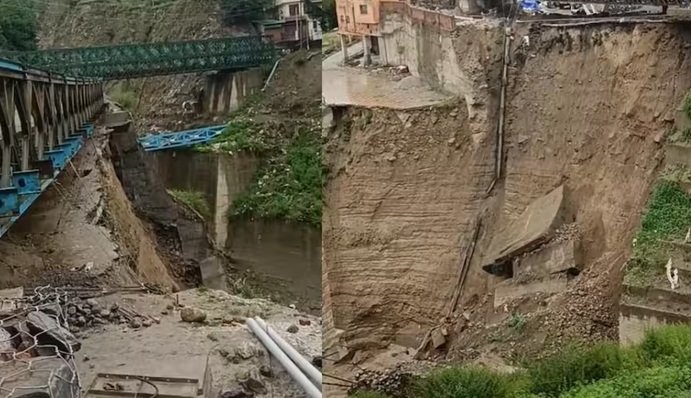
Sangla (Rajeev Sharma): The impact of the southwest monsoon continues to be felt across Himachal Pradesh, where heavy rainfall has damaged infrastructure, disrupted transport and isolated several remote areas. A Bailey bridge in Kinnaur district collapsed after remaining unstable for days, while hundreds of roads across the state continue to remain closed due to landslides and debris.
The bridge, which served as an important link to the Sangla Valley, had become unsafe after torrential rain triggered erosion beneath its foundation. Authorities had already suspended traffic over the structure before it finally collapsed, cutting off one of the key routes in the region.
The Public Works Department is working to restore connectivity, but officials say reopening blocked routes may take time as continuous rain has complicated restoration efforts. According to the latest updates, nearly 320 roads remain inaccessible, while damage to the power network has left more than 200 electricity transformers out of operation.
Weather data indicates that Himachal Pradesh has received substantially more rainfall than its seasonal average this month. Between July 1 and July 10, precipitation has exceeded normal levels by more than 50 per cent, increasing the risk of landslides, flash floods and slope failures in several districts.
Despite a slight reduction in rainfall intensity over the coming days, the India Meteorological Department (IMD) has maintained a yellow alert for Kangra, Kullu, Mandi, Shimla, Solan and Sirmaur. Residents have been advised to remain vigilant, particularly in hilly areas where unstable slopes continue to pose a threat.
The prolonged wet spell has also brought an unusual dip in temperatures. Tourist destinations such as Shimla and Manali, along with Bhuntar and Solan, have recorded daytime temperatures well below the seasonal average due to persistent cloud cover and rain.
Meteorologists expect weather conditions to improve briefly during the middle of the month, allowing temperatures to recover gradually. However, forecasts suggest that the respite will be temporary, with another active phase of the monsoon likely to affect the state during the third week of July.
Officials have appealed to residents and visitors to avoid travel on vulnerable mountain roads, follow district advisories and stay away from rivers and landslide-prone areas until weather conditions stabilise. Emergency response teams remain on standby as authorities continue to monitor the evolving monsoon situation across the state.
