

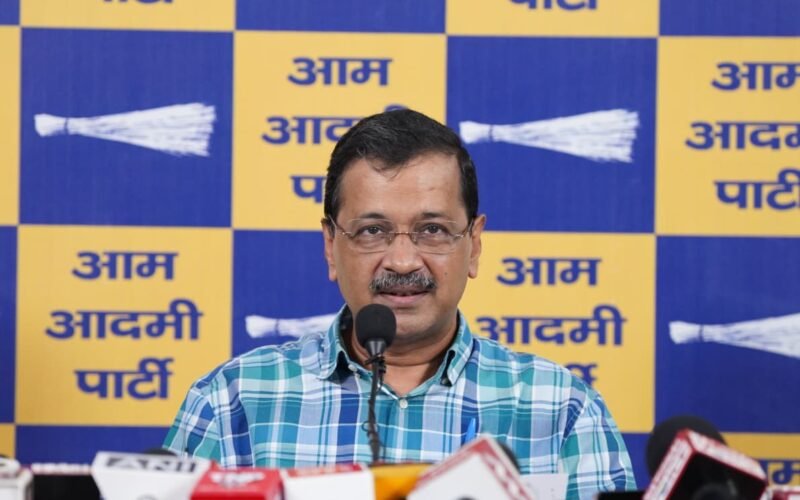
Chandigarh (Gurpreet Singh): Aam Aadmi Party (AAP) National Convenor Arvind Kejriwal has sharply criticized the central government over fuel pricing, claiming citizens are being forced to pay inflated rates for petrol and diesel despite a substantial drop in international crude oil prices. Speaking at a press conference in New Delhi, Kejriwal asseted that while global crude oil has fallen to 70 dollars per barrel, the government continues to retail E20-blended petrol at an unjustified 102 rupees per litre. According to his calculations, pure petrol should retail at 82 rupees per litre, while the E20-blended variant should be priced significantly lower at approximately 70 rupees per litre.
Detailing his pricing breakdown, the AAP leader explained that at the current global rate of 70 dollars per barrel, the raw cost of crude oil translates to 42 rupees per litre. Keeping all other refining costs, transportation fees, and dealer commissions steady at nine rupees and three rupees respectively, alongside 12 rupees for central taxes and an average state VAT of 25 per cent, the final cost for pure petrol should strictly be 82 rupees per litre. Kejriwal emphasized that lowering petrol and diesel rates would provide immediate relief to the public by curbing transportation costs, which in turn would trigger a downward trend in overall inflation across the country.
The AAP supremo also firmly rejected the justification offered by Union Minister Hardeep Puri that oil marketing companies must maintain higher prices to recover financial losses suffered during the recent conflict in the Middle East. Pointing to corporate earnings, Kejriwal highlighted that these state-backed oil firms accumulated a massive profit of 77,000 rupees crore last year alone, and nearly two lakh rupees crore over the past three financial years. He argued that these substantial reserves should easily absorb any temporary wartime losses rather than penalizing the public with artificial price hikes, urging the federal administration to stop exploiting the conflict as a pretext for corporate profiteering.
