

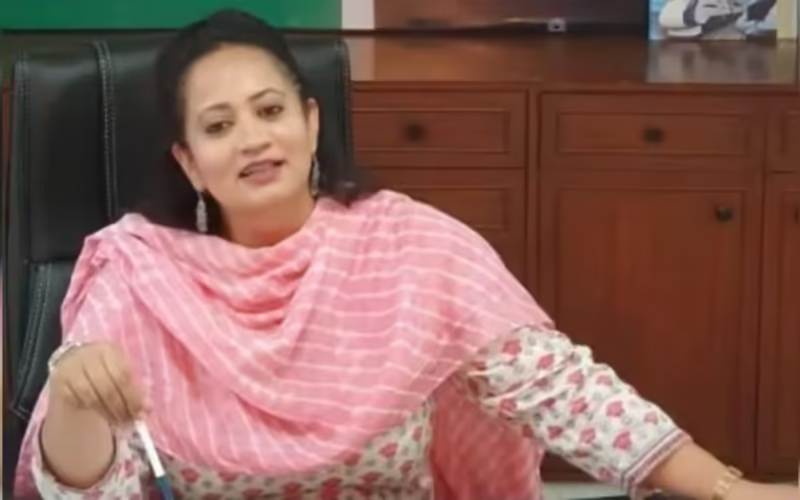
Chandigarh (Balwinder Singh) Haryana Health Minister Aarti Singh Rao announced that the state government is taking continuous steps to further strengthen healthcare services across the region. Speaking after a meeting of the “Special High-Powered Purchase Committee” held under her chairpersonship, the Health Minister shared that the committee has finalized and approved procurement proposals and rate contracts worth over ₹18 crore to reinforce the medical framework and healthcare infrastructure throughout the state.
Detailing the critical components of the cleared funds, the Health Minister explained that several vital procurement decisions were locked in during the session. These include the acquisition of 40 variants of Unani medicines valued at approximately ₹1.85 crore, intraocular lenses (IOL) worth ₹44 lakh earmarked for cataract surgeries, and specialized lifesaving medications totaling ₹82 lakh dedicated to thalassemia patients.
To introduce long-term structural upgrades to regional emergency services, the committee finalized a two-year rate contract worth roughly ₹9.55 crore for the purchase and installation of 18 Liquid Medical Oxygen (LMO) plants and storage tanks across 18 district civil hospitals. Furthermore, a separate two-year rate contract valued at ₹3.02 crore was approved to supply 24 pure-tone audiometers across 22 district civil hospitals. Under a public-private partnership (PPP) framework, the panel also sanctioned a ₹2.40 crore tender to roll out operational hemodialysis services across 16 sub-divisional civil hospitals.
Aarti Singh Rao emphasized that these tailored medical procurements will deliver immediate relief and significantly improve the quality of life for diverse patient demographics in Haryana. For instance, the seamless availability of dedicated thalassemia drugs guarantees uninterrupted treatment for individuals battling this genetic blood disorder. Similarly, the bulk procurement of intraocular lenses will allow elderly citizens to access affordable, government-backed cataract surgeries without agonizing wait times, while the expansion of Unani medicines integrates holistic and alternative therapeutic choices within the public healthcare apparatus.
The Health Minister concluded that these long-term infrastructure overhauls will drastically elevate the overall reliability of medical treatments at the grassroots level. Operating local LMO plants ensures an independent, continuous oxygen supply for critical emergency cases and surgeries, heavily reducing the need to refer patients to major metropolis hospitals. Additionally, local audiometers will enable early diagnostic checks for hearing impairments, while the rollout of close-to-home dialysis units will insulate kidney patients from the severe financial strain of traveling long distances for expensive private care, reflecting the administration’s core commitment to accessible and high-quality civic healthcare.
